“Archaeology has been profoundly malleable as a symbolic exercise, its discoveries are laden with additional meaning, and its process can be compared to detective work (Shanks 1996) or performance (Shanks 2004, 2012). Importantly, at various points there has been a greater emphasis on archaeology as the recovery of fragments, rather than the whole picture. Archaeology recovers what remains, and is always partial, so the role of the fragment as a clue, as a sign, as a symbol of loss as much as survival. (Smith, 2017). Christopher Smith has presented in his article, Beyond Metaphor: Archaeology as a Social and Artistic Practice, several case studies of the deployment of archaeology in contemporary broader discourse and art practice arguing that it is a way to redeem and safeguard the past, offering a sen<se of grounding and support for the present. Its complex connection to modernism lies in the idea that the past shares a deeper alignment with what is considered real.
Another relation between Archaeology and art is the claim that the artist’s understanding of a landscape as somehow revelatory for an archaeologist. The unmediated gaze of the artist can reveal what scholars fail to see; they study creativity but do not understand it.
The methodology adopted for “Archaeology in the Presence” aligns with a wider trajectory in contemporary socially engaged art, where artists approach border zones of conflict not as sites for traditional archaeological excavation, but as spaces layered with lived emotions, memory, and social tension. In this context, “archaeology” becomes a generative concept, an embodied form of inquiry that foregrounds the complex relations between present-day cultural practices and the enduring effects of collective trauma. Rather than cataloging material remains, this initiative centers on the intangible: narratives, rituals, shared fears, and aspirations circulating within the community.
Comparable approaches can be traced in recent interdisciplinary movements such as Experimental Heritage, where artists and researchers collaboratively investigate how current emotional realities intersect with historical legacies, often privileging the affective and communal over the tangible or archival. Such models highlight how processes of creative engagement serve as means to surface and hold space for fragile, threatened, or silenced aspects of cultural identity, especially among populations negotiating the ongoing pressures of conflict.
By situating creative residencies directly in these vulnerable contexts, Archaeology in the Presence aims at cultivating vivid encounters, fostering open-ended exploration, dialogue, and collective meaning-making focused wholly on the present. This reconceptualised archaeological approach makes new pathways for recognition, healing, and the reimagining of community narratives possible, suggesting that the most urgent work may lie not in the recovery of artifacts, but in attentive reckoning with what is felt, feared, and remembered today.
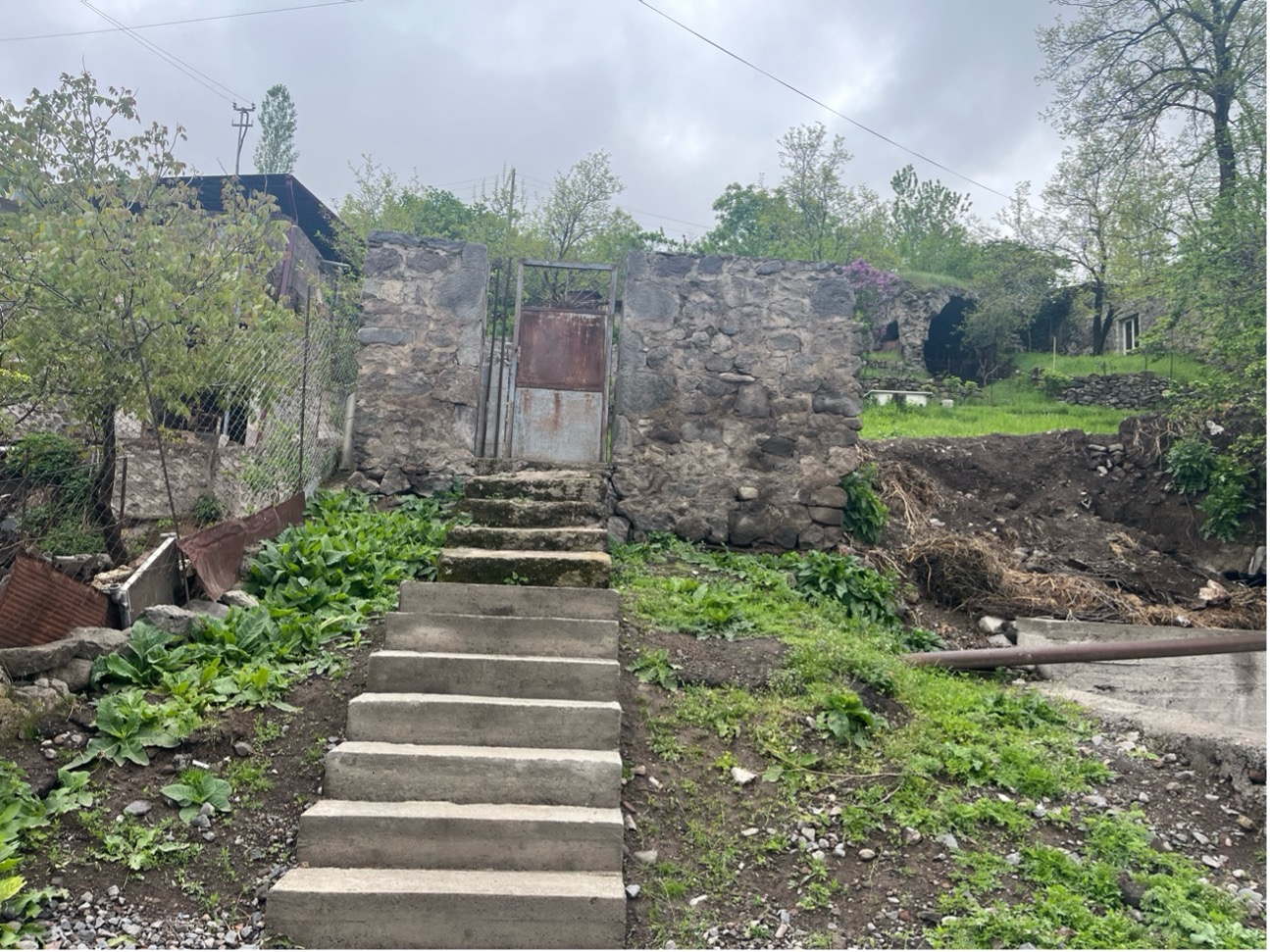
In May 2025 I went on an exploratory and preparation trip to Syunik region, one of the tensest regions in Armenia at the time of writing this account in July 2025), where the Archaeology project was planned to take place in October of the same year. With two Armenian friends we have spent few days meeting people and walking around, trying to understand the reality of where we are, so we can offer a starting point for the artists joining the project.
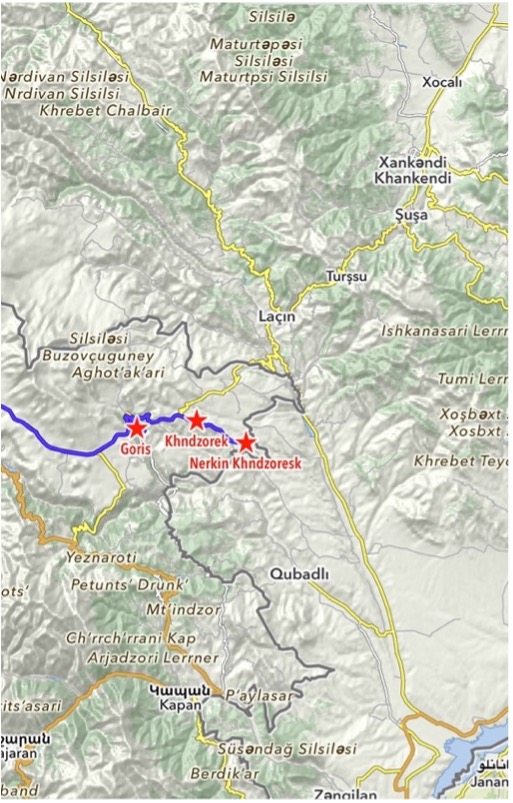
We started in Goris, the biggest city in that region but encounters led us to Khndzoresk and Nerkin-Khndzoresk situated at the borders with Azerbaijan and at 94 KM road to Khankendi, (Stepanakert, capital of Artsakh for Armenians.)
Hermine and Arthur, schoolteachers from Nerkin-Khndzoresk who we know from a previous project of artasfoundation have met us in Goris and took a car ride with us to their village for tea and sweets.
I asked them if I could record part of our conversation and they were generous sharing their life through taking us to see where they work how they live and the alternatives they have created to sustain their livelihood through war.
In 1986 they moved from Khndzoresk to Nerkin Khndzoresk where they built their house in 1989. The village was identified as such 1983 only (during Soviet Union), a politician visited and considered the living situation of people to be unacceptable and started to build better houses. Living through these years, people are not used to live as a community. Interactions are rate and so much concentrated within family. “We live in a very small border village, activating any societal dynamics is very hard. We do imagine a peaceful future where more people can live in our village which will create a stronger sense of community. We have tried for so long to convince people to go to the music school in Khndzoresk while taking our own kids to the school or club”.
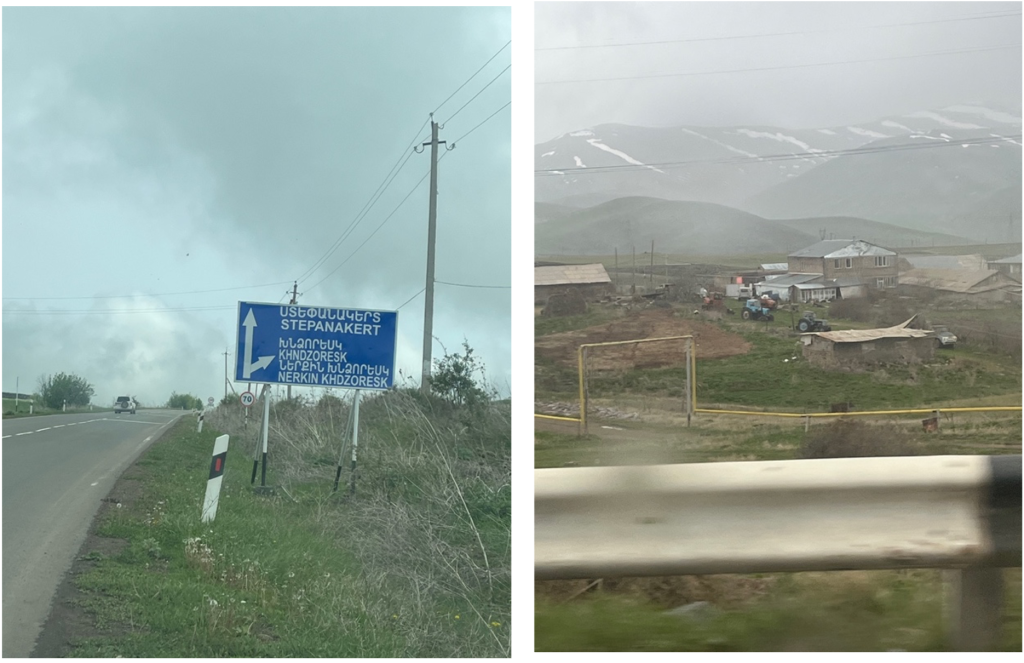
Living in a border village brings this tension and fear. After 2020, no one allow their kids to leave the houses out of fear of shootings. Before the war people used to leave the house without mobile phones, but “after the war I learned to always keep it on me after being locked outside few times” said Arthur. He continues: “whenever the shooting starts everyone hide and lock their doors, knocking does not help as soldiers do come and knock on doors and speak Armenian to residents, so no one open their doors. This changed a lot in people’s lives. After 5 everyone is at home. We are happy there is a new road being built and we expect it to change our lives, but the government decided to close the small schools in the smaller villages including ours which will destroy the village life. No matter what kind of community life we try to have (clubs or other activities) without a school, with people taking their kids to other cities, they will slowly consider living there. It is very expensive to live here, from household to education. There is only one car reaching us bringing supplies otherwise we must go to the city for grocery.
Art has always helped me to look at things from out of the ordinary perspective, this is what I value. After 2020 art activities helped in distracting people especially for the younger generation. Physically and mentally art helps to overcome what they went through. When thinking of the development of the village, I can see that the government means something else not focused on the social life. social activities through arts lead to a more advanced living situation. Art gives us the feeling that there is something else beyond what we live. Art is not only about knowledge but about a full scope of skills and abilities that could be used in different situations.
A couple of days ago, a Dutch group was here, the band name was Apricot Tree, they were playing Armenian music, there have been songs by Camitas for example. There, you could immediately identify the kids who regularly go to art clubs, because they can sit and listen. The ones who never went to those activities, regardless of if they like the songs or not, simply cannot concentrate their attention and deal with their feelings.
Those events happen two or three times a year. In most cases groups do not return.
XXX, who has an engineering background, showed us their Hydroponic Fodder System, which was installed to replace the fields lost during the 2020 war and ensure sufficient food for their animals. To power the system, he also installed solar panels. The whole cycle lasts for seven days but very high-quality seeds should be used and these are expensive. Sometimes they grow more than they need so they give other neighbors.
Arthur is currently building a community center, a house nearby the school but he is also waiting now for the decision of him being appointed as the school principal. After this is done he will be focused on activating the community center.
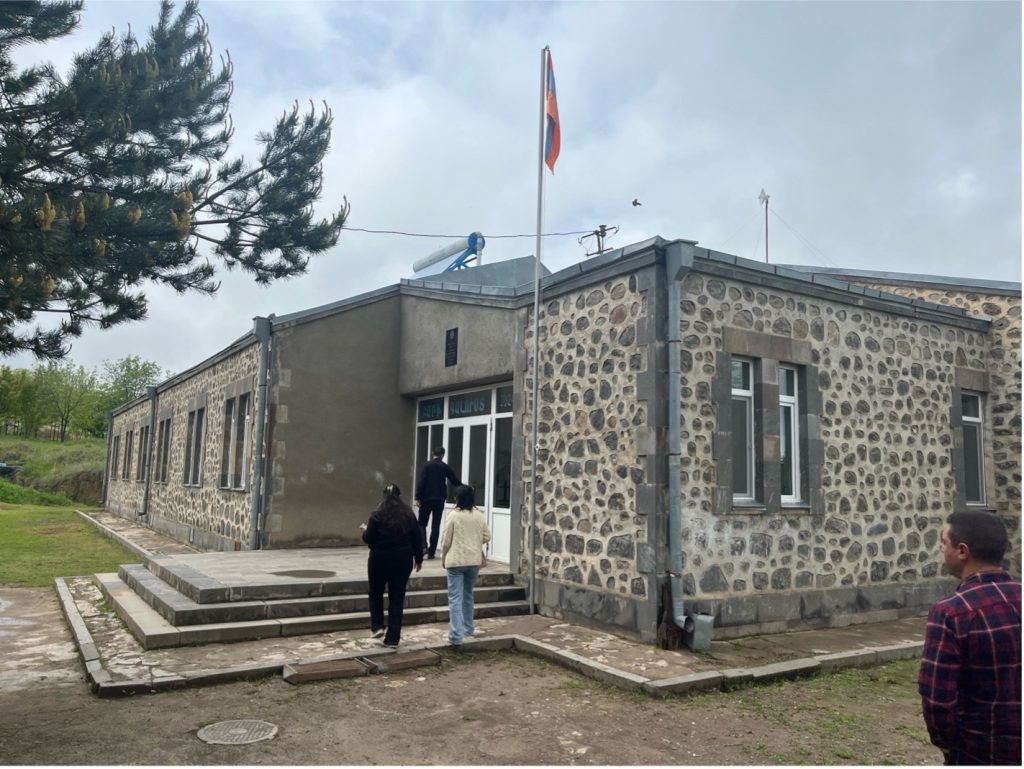
Back to the school we have visited before reaching Hermine and XXX’s house, it is a very small school that is visited by 30 kids from the first to the 12th grade. Tiny classrooms, a library, art room and a playground.
Soldiers killed are memorized in their classrooms. Many photos of young men were hanged in the center of these rooms
Walking along the roads of Nerkin-Khndzoresk, I remembered what I had read about the peace activist and founder of the Caucasus Center for Peacemaking Initiatives, Georgi Vanyan. Georgi was an Azerbaijani, ethnically Armenian peace activist, renowned for being radical and singular in his efforts to break away from liberal peacebuilding processes. He chose instead to establish his own initiatives in a small Georgian border village near Armenia and Azerbaijan, where he founded the grassroots Tekali Process. “Participants of the Tekali process have never been part of NGOs, they have been people from the surrounding villages. That process was exceptional. No such programmes have ever been made with people from Karabakh, veterans, refugees, family members of the victims, and those living in border villages. This is the biggest problem of peacebuilding. In my opinion, there can be no peacebuilding until there is a process with those people. I don’t believe that any organisation sitting in an office in Yerevan can bring peace to people. It can contribute to the creation and dissemination of discourses, it can use social capital to bring different kinds of support to that process, but peacebuilding must be the movement of people, the movement of beneficiaries who will come and say, ‘We are residents of the border region”. (Ishkanian, Manusyan, Khalatyan, Margaryan, 2023, p.203)While currently, due to direct violence, it is impossible to think of crossing border villages for neighbors to be in one room, I could imagine art grassroot initiatives insinuating collective imagination of better togetherness…
With the promises to see Hermine and Arthur again in October, we left the village back to Goris and from there to Yerevan.