Reflections from the “Archaeology in the Presence” Art Residency, Goris, Armenia.
By Habib Afsar
Archeology in the Presence is a community based art residency where I join eleven other artists for 10 days engaging with the local community in Goris, a border town of Armenia. Our objectives are to explore people’s conception of the future in aconflict affected region and how art can contribute to better coping. The artists belong from Switzerland, Armenia, Srilanka, Germany, Georgia and, myself from Pakistan. The residency concludes with a small festival to celebrate and showcase the work. The intervention is part off a bigger research project tiled Contemporary Art, Popular Culture and Peace-building in Eastern Europe.
1. Listening
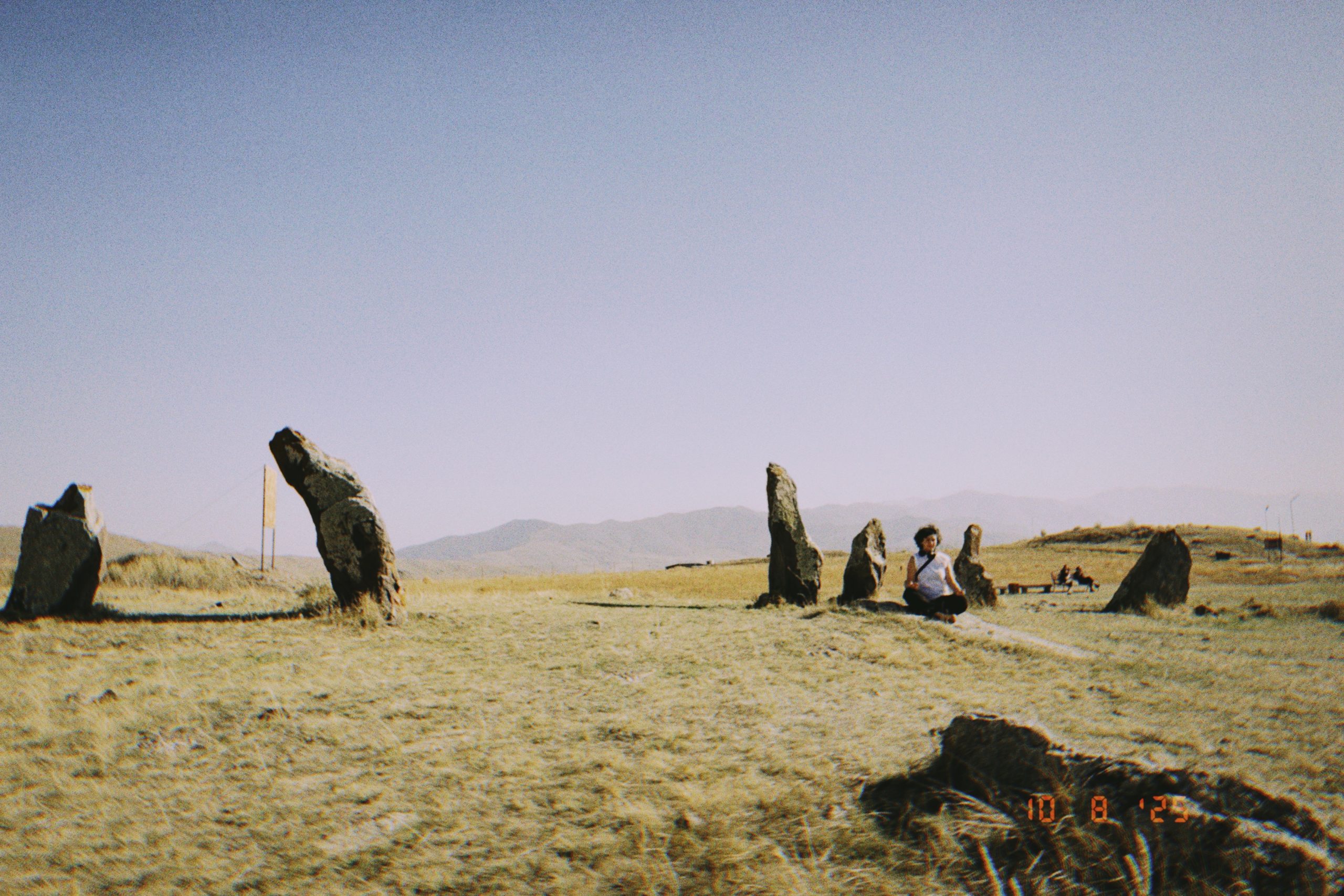
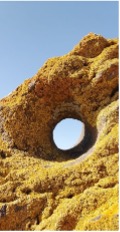
The road from Yerevan to Goris winds through mountains the colour of honey and rust. Somewhere between the turns, we stop at Zorats Qarer—the “Talking Rocks”. The megaliths rise from the hill like a circle of wise elders in consultation, each stone drilled with a perfect circular hole, angled to the stars. No one knows how they were made. Silence gathers easily here. The wind sings through the stones; I listen and wonder at the strange ancient language I can barely decipher—are these sounds fromthe air whistling through the rocks or my own imagining?
The rock speaks:
You forget that you belong – that you have a place among us,
That I am your ancestor,
That we are all descended from stars.
This land that you claim is not yours- it is you
And neither is it theirs- it is them
It is ours and not ours,
Just as She has no name, for all names belong to her.
The peace you yearn for comes from health,
health from healing,
healing from wholeness.
Do not cast away what is unpleasant;
The wound is where you may see through to the Real.
Before leaving, I enter the small gift shop. A ceramic locket with an ancient hieroglyph catches my eye—a moon crossing thesun, an eclipse, a symbol of disruption and renewal. It slips from my hand and falls to the floor as I stumble over the threshold.A sign, perhaps, that I must tread carefully. I pause and ask permission before wearing it. It feels right when I do.
Breathe
2. Naming
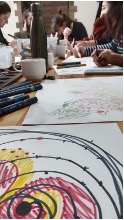
Each morning one of us leads a creative ritual. My contribution is a Naming Poem—a resource-oriented exercise exploring identity as imaginative ground.
My name is a drunk worm,
An all-knowing power in cosmic conversation,
My name is the wisdom of a fish,
Intense and detailed.
A disaster waiting?
My name will look you in the eye,
It will carry you in the storm, in a spaceship of Joy-
Call me Habib
Breathe
Someone mutters, “Feels like an ego trip.”
I have an eureka moment: ego—so often vilified—is not the enemy of but a boundary, a necessary skin. Ego ensures survival by locating the self in time and relation through notions of identity. When identity becomes rigid, it breeds defensiveness and fear; when it collapses, coherence dissolves into chaos. A healthy ego can play with identities without being enslaved by them. It knows connection is survival and it thrives through the other. Peace, then, can be selfish in the best way: The ego not as obstacle but a bridge.
Art may be the safe container where identity can expand and contract freely- though only when we step out of survival mode, even briefly, can the art truly happen.
Let the poetry begin!
3. Encountering
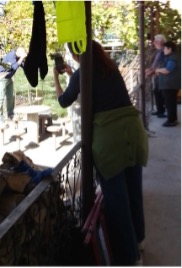
In the portrait photography workshop, the Armenia artist facilitator teaches that rapport must precede image. We meet an elderly couple—refugees from Nagorno-Karabakh—who invite our entire group for bread, cheese, and home-brewed vodka. I don’t understand the words, but I feel the warmth of their story. Their wrinkles speak of a life well-laughed. The eyes show pain. There are teary smiles and deep sighs. The portrait is taken. It seems they have given us more than we have them.
Later, we meet a retired soldier. He has fought in wars across the world and now cannot travel because of an international arrest warrant. When he learns I am from Pakistan, he asks why Pakistani mercenaries fight in the conflict here. His tone hardens.
“I don’t know,” I answer quietly. “I’m here to listen—to listen to your story and share in your life for a moment… I’m a mercenary of love… And for whatever it’s worth, I’m sorry.”
The old soldiers expression softensThe artist intervenes—he suggest a portrait together. In the photograph, we stand shoulder to shoulder, two men shaped by different histories but bound, for an instant, by an encounter. I place my arm gingerly around his back. As I stare into the camera, I realize I am olding my breath.
The image is intense, both of us staring into the lens. I realise the art is not the photograph; it is the encounter. The photographis just an artefact- a memory. The camera is a tool. The clicking a ritual. The camera, the ritual, or the workshop is valuable only insofar as it enables encounter. Was the portrait an excuse for the encounter or the other way around. Does it really matter? And if the art lies in the relation then who really is theartist? Have we made a piece of peace with the click of a camera? How many clicks can make the difference?
Breathe
4. Teaching
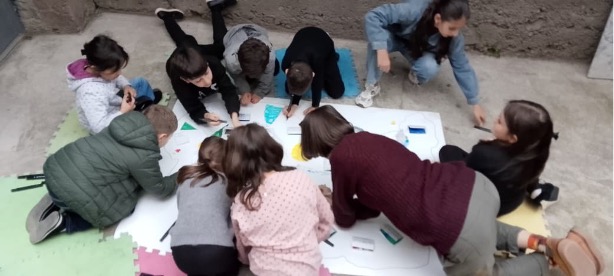
At an after-school art camp, Eliza, an Armenian artist and I work with children aged eight to eleven to create a Museum of Friendship. Our first activity uses recycled paper to make objects that “speak.” The paper flower says, “Smell me.” The paper ball says, “It will be fun to play together”. The paper microphone asks, “When will you make a new song that I can sing along with you?”
I teach them to notice their breath—to pause before reacting. When angry or stressed, take a deep breath, then another. The session is joyful chaos, but the teacher disapproves: “They should make something beautiful, not play with trash.” In our evening de-brief one of the younger artist agrees.
I bite back my defensiveness. By the third session, she understands what is happening- we are feeling and expressing and exploring and encountering the other – we are taking risks and trying out new ideas and new ways to do things – we are workingto make something beautiful- all the while playing- we are doing art. The teacher brings us tea and apples from her tree.
When one boy storms off, threatening to smash the phone of the bigger boy who pushed him, I signal him to breathe. He does—and smiles, returning the phone. The lesson is learned by all of us.
Breath is the smallest unit of peace. It can hold a world of space.
Breathe
5. Dismembering
In Armenia, the narrative of suffering and survival runs deep. The memory of genocide and recent loss shapes the collective psyche. Every child draws the national flag; every adult speaks of uncertainty.
“ I am worried that we will continue to suffer like this until there is no Armenia left”. “How can we change?”, asks one of the Armenian artist
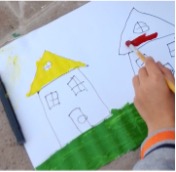
And so it is that when a child draws an Armenian flag on the “Friendship Map of Goris” we create with them, Eliza says , “No lets put something else. There are so many Armenian flags already”. As an outsider I may not have had the courage to say that. And so I am excited tothe possibility of a change in narrative- but it cannot be imposed from outside—it must arise from within.
As artists, our task is to create spaces where new stories can emerge safely. Butbefore that the old narrative needs to be de-constructed. Dis-membered like Osiris. Narrative transformation is not denial but evolution: honouring pain without becoming its hostage. Acommunity that can reimagine its story is already healing.
Art offers this space—through words, colour, sound, and gesture—to rewrite what it means to belong and to hope. Evolution, not revolution. Slow, like mountains eroding into new landscapes.
6. Creating
On the final day, our “Museum of Friendship” opens in the park—cardboard walls stitched with red thread and suspended between trees. Children’s drawings, poems, and letters flutter like leaves. On the outside walls, one of the Armenian artist has done some “street art” on my request- it is a the image from a dream I had the night before we came to Armenia. I told him about the dream after he finished painting- I hear Jesus is in town to take awaythe fish- the town people draw a bull in celebration and parade it through the streets. There is a big party…
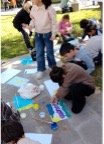
Outside the, I set paints, brushes and paper on the grass. Noinvitation is needed; the children swarm like bright fish. For hours they draw: houses, mountains, people, patterns—and, to my surprise, portraitsof me. Even the wild boy who would rather make paper planes than draw finally paints a ship at seawith a single Armenian flag. He says it’s a gift for me.
“Give a boy a brush and he will paint,” I say. “Give him a gun and he will shoot.” My colleague replies, “It’s not that simple.”
Perhaps not. But surely the choice of tool shapes the story we tell.
Breathe
7. Remembering
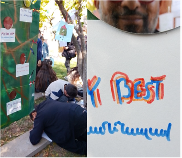
Jack is proudly showing his parents the exhibit that he is a part of. I point to a small mirror on the wall labelled My Best Friend.
“Yes, I know,” he says— He had created all the labels for the museum “But look closely Jack,” I say. “Who do you really see?”.
He peers into his own reflection- like an archeologist in the presence-taking a moment tounderstand what I am trying to tell him. A moment of recognition—a broad smile. And in that instant, I realise that art is not artefact rather a relationship—and peace feels less like a destination and more like an encounter- a moment of breath held between beings.
Habib A. Afsar, Armenia, 2025