Publikation “Die Hardau”
Juni 22nd, 2012Die Fachstelle Kunst und Bau der Stadt Zürich und das Institut für Gegenwartskunst der Zürcher der Hochschule der Künste bringen eine Publikation zur Hardau heraus, die anlässlich des Quartierfests am 30. Juni lanciert wird.
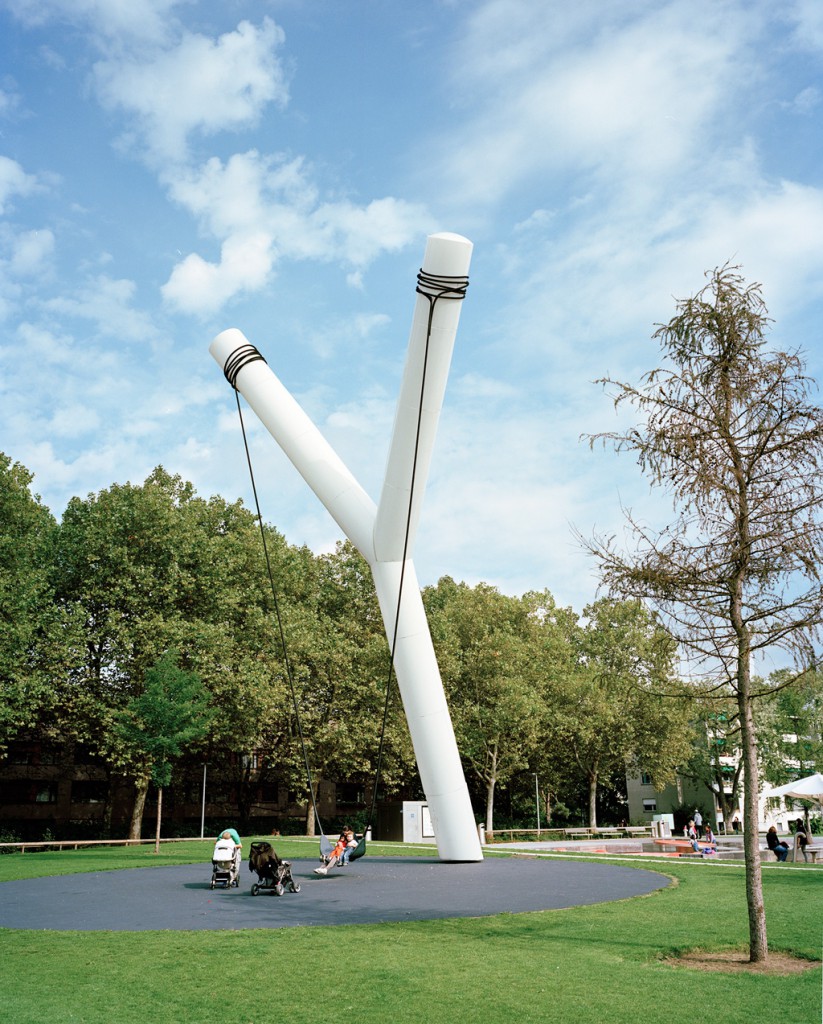
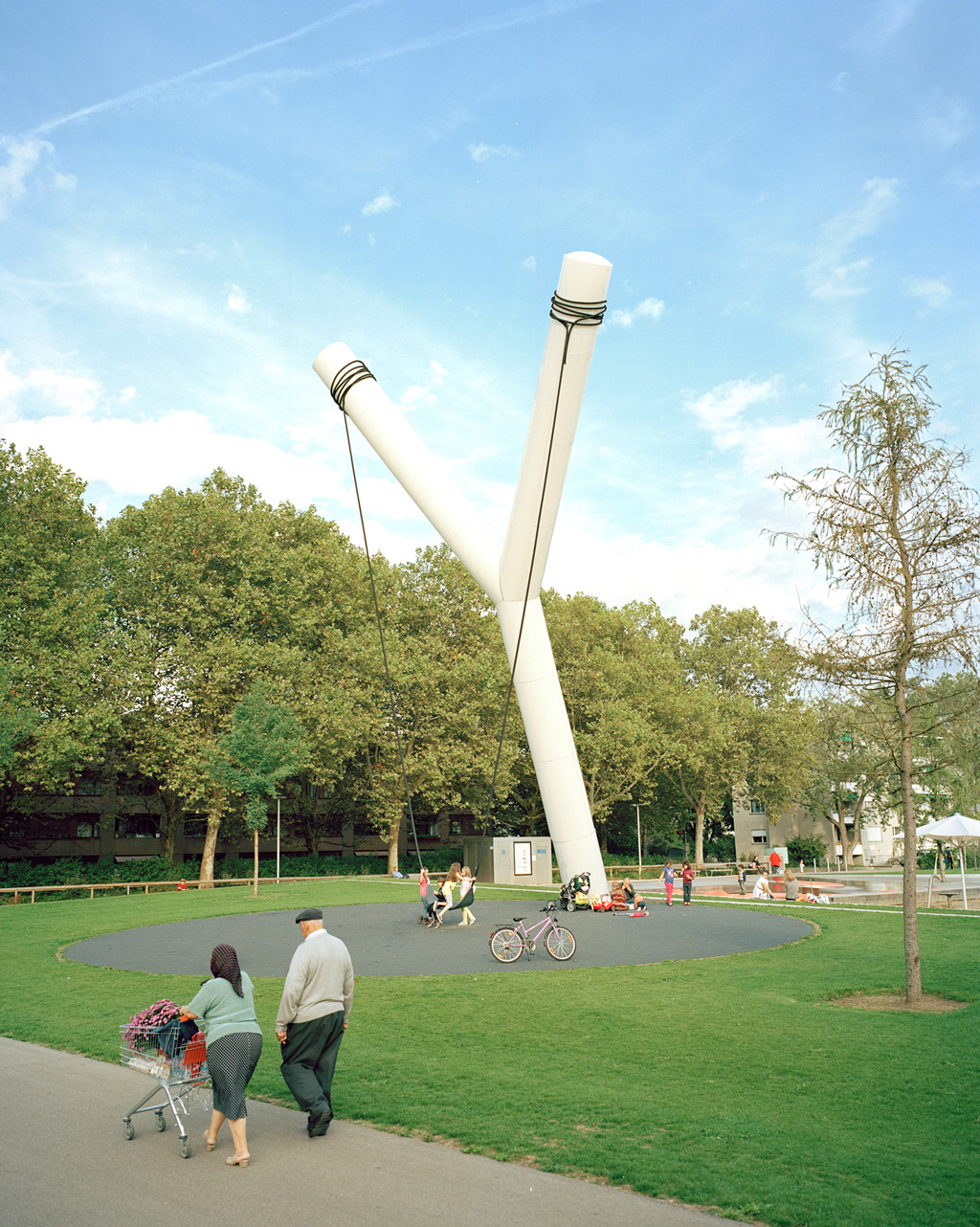
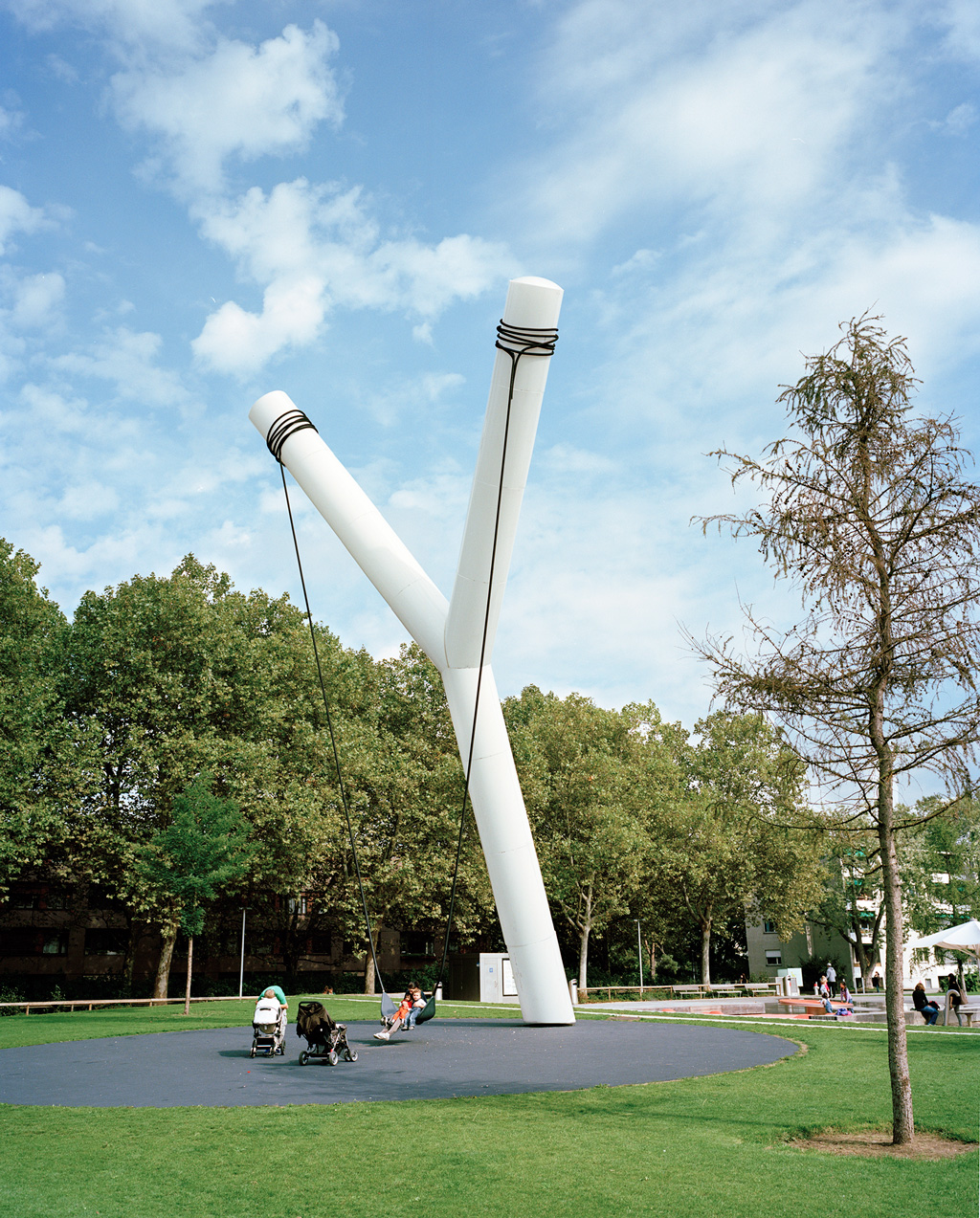
Die als Quartierführer konzipierte Publikation erscheint im Zusammenhang der fertiggestellten Kunstwerke «Y» von Sislej Xhafa im Hardaupark und «Das Haus im Haus» von Zilla Leutenegger im Oberstufenschulhaus Albisriederplatz. In über 20 Beiträgen gibt das Booklet unterschiedlichste Einblicke in die Besonderheiten dieser Nachbarschaft bettet die im Hardaugebiet realisierte Kunst in den charakteristischen Lebenskontext des Quartiers ein. Denn gesellschaftliche, wirtschaftliche, städtebauliche und kulturelle Aspekte bilden die Faktoren, auf die die Kunstwerke Bezug nehmen. Und sie stellen das Umfeld dar, mit dem die Werke wiederum in Dialog treten.
Mit Beiträgen von: Annemarie Bucher, Kathleen Bühler, Beat Grossrieder, Michael Hiltbrunner, Jürgen Krusche, Christoph Lang, Sascha Renner, Christian Ritter, Christoph Schenker,
Charlotte Tschumi
Fotos: Eliane Rutishauser
Gestaltung: Beat Cadruvi
ISBN 978-3-9523690-2-9
Erhältlich für Fr. 10.- beim Amt für Hochbauten der Stadt Zürich
Mehr Informationen als PDF
Sommerfest und Picnic im Hardaupark
Juni 1st, 2012Spiel Spass Musik Tanz Infos Grill Getränke
Am Samstag, 30. Juni 2012 von 15 bis 22 Uhr
um 17 Uhr offizielle Übergabe des Parks an die Bevölkerung durch Stadträtin Ruth Genner.
Bei schlechtem Wetter findet das Fest im Oberstufenschulhaus Albisriederplatz statt.
Medienmitteilung der Stadt Zürich zur Parkeröffnung
Hardaupark Fotos
Juni 1st, 2012Fotos vom Hardaupark auf der Facebook-Seite von Grün Stadt Zürich.
Videobeitrag über Art Loops
Mai 17th, 2012Auf http://www.internettv.ch gibt es einen Beitrag über die Kunstspaziergänge Art Loops des Künstlers Matteo Hofer. Im Beitrag wird aufs Hardau-Quartier fokussiert, das Video kann unter folgendem Link betrachtet werden:
http://www.internettv.ch/regionen/zurich/art-loops
Realisation des Internetvideos: Marius Stahlberger
Weitere Links:
Eröffnung Hardaupark am 30. Juni
April 20th, 2012Der Hardaupark wird am Samstag 30. Juni 2012 offiziell eröffnet. Am gleichen Tag findet das traditionelle Quartierfest in der Hardau statt. Weitere Informationen hier
Sislej Xhafa – Mahnmal und Schaukel
November 30th, 2011Im Kunstbulletin (11/2011) erschien folgende Besprechung des Y von Brita Polzer :
Zum Wettbewerb für die Arbeit im Stadtpark Hardau wurden ausschliesslich Kunstschaffende aus Osteuropa eingeladen. Denn im Quartier leben viele östliche Immigrant/innen und man hofft, dass diese sich so mit der Kunst eher identifizieren können. Gewonnen hat der Kosovare Sislej Xhafa.
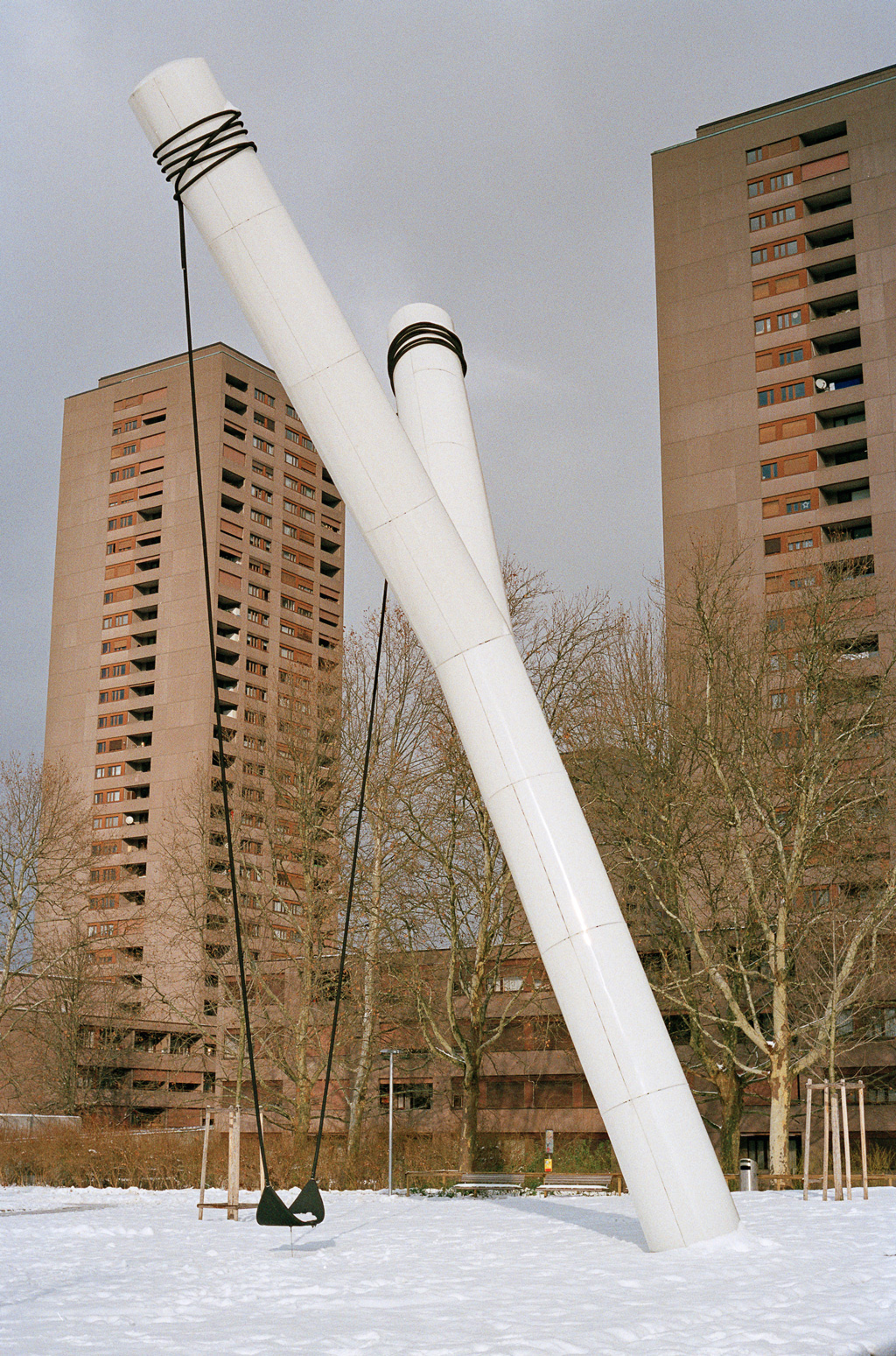
Es sei stets eine besondere Freude, ein Kunstwerk zu eröffnen, sagt die Stadträtin Ruth Genner. Das Quartier könne neben den vier Hardau-Türmen nun ein weiteres Wahrzeichen aufweisen und die Stadt habe insgesamt mittlerweile 180 Millionen in diesen seit je von vielen Migranten bewohnten Stadtteil investiert. Tatsächlich ist die Umgebung der in den Siebzigerjahren erbauten und vor einigen Jahren sanierten Hardau-Hochhäuser kaum wiederzuerkennen. Ein neues Schulhaus strahlt Energie und architektonisch städtische Zuwendung aus, eine Wohnüberbauung -
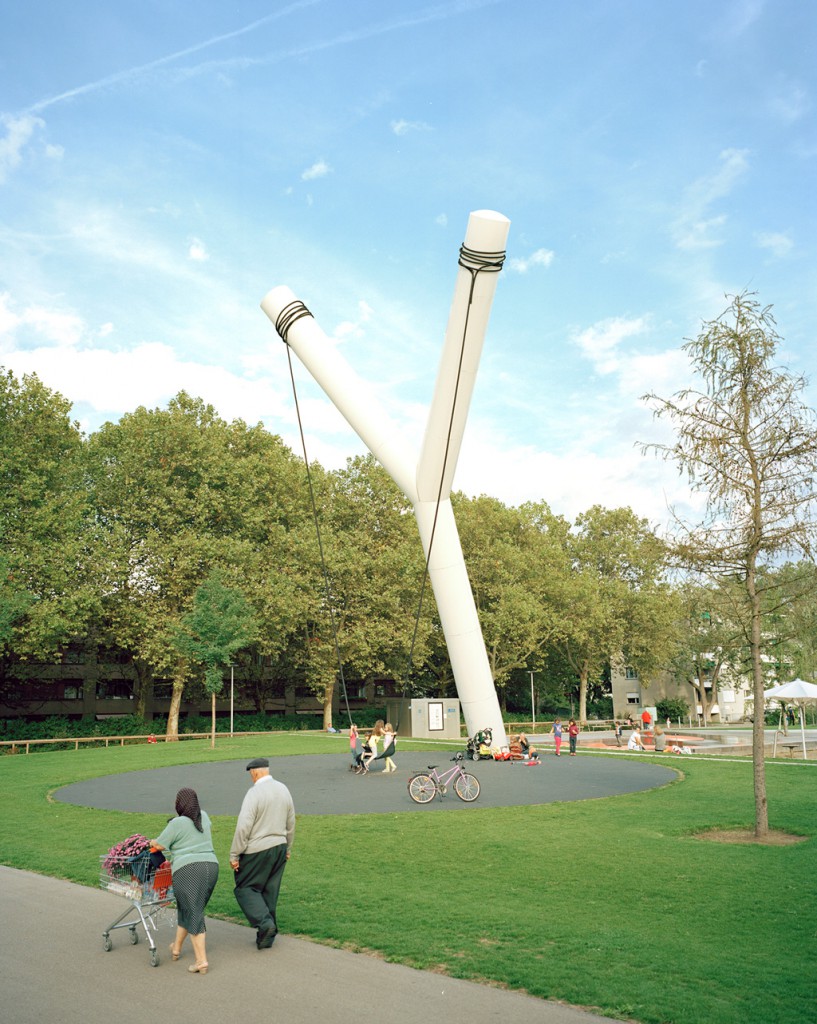
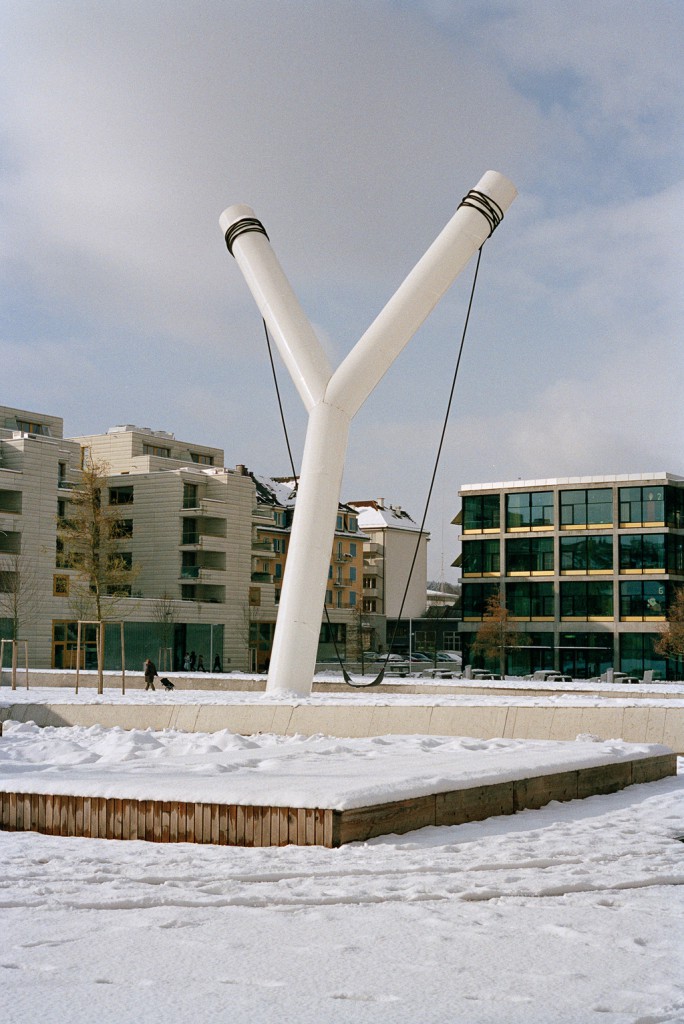
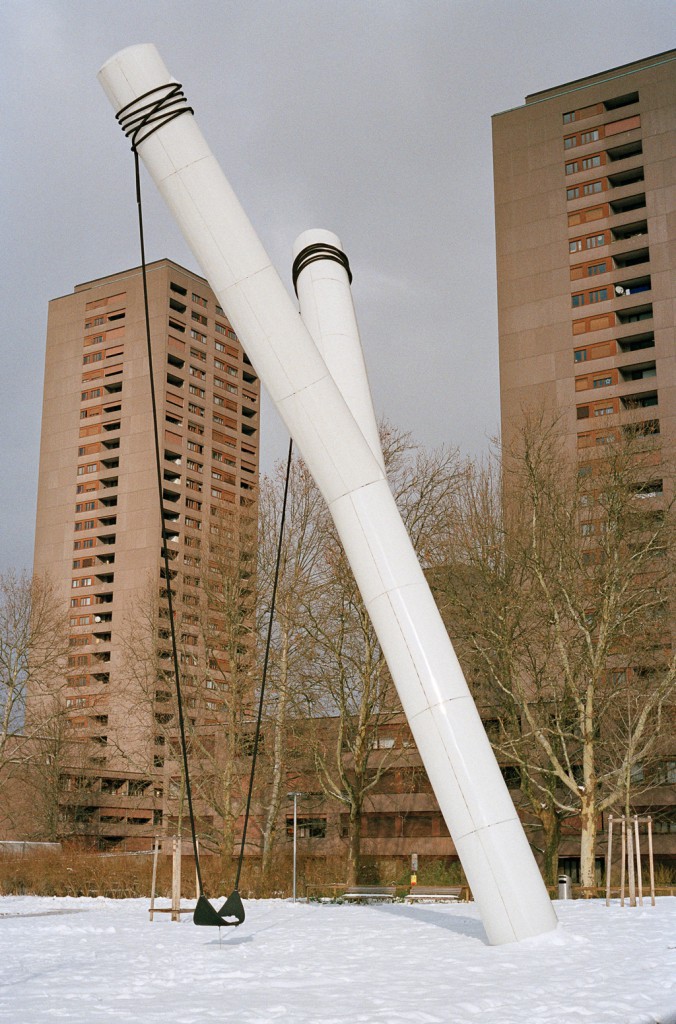
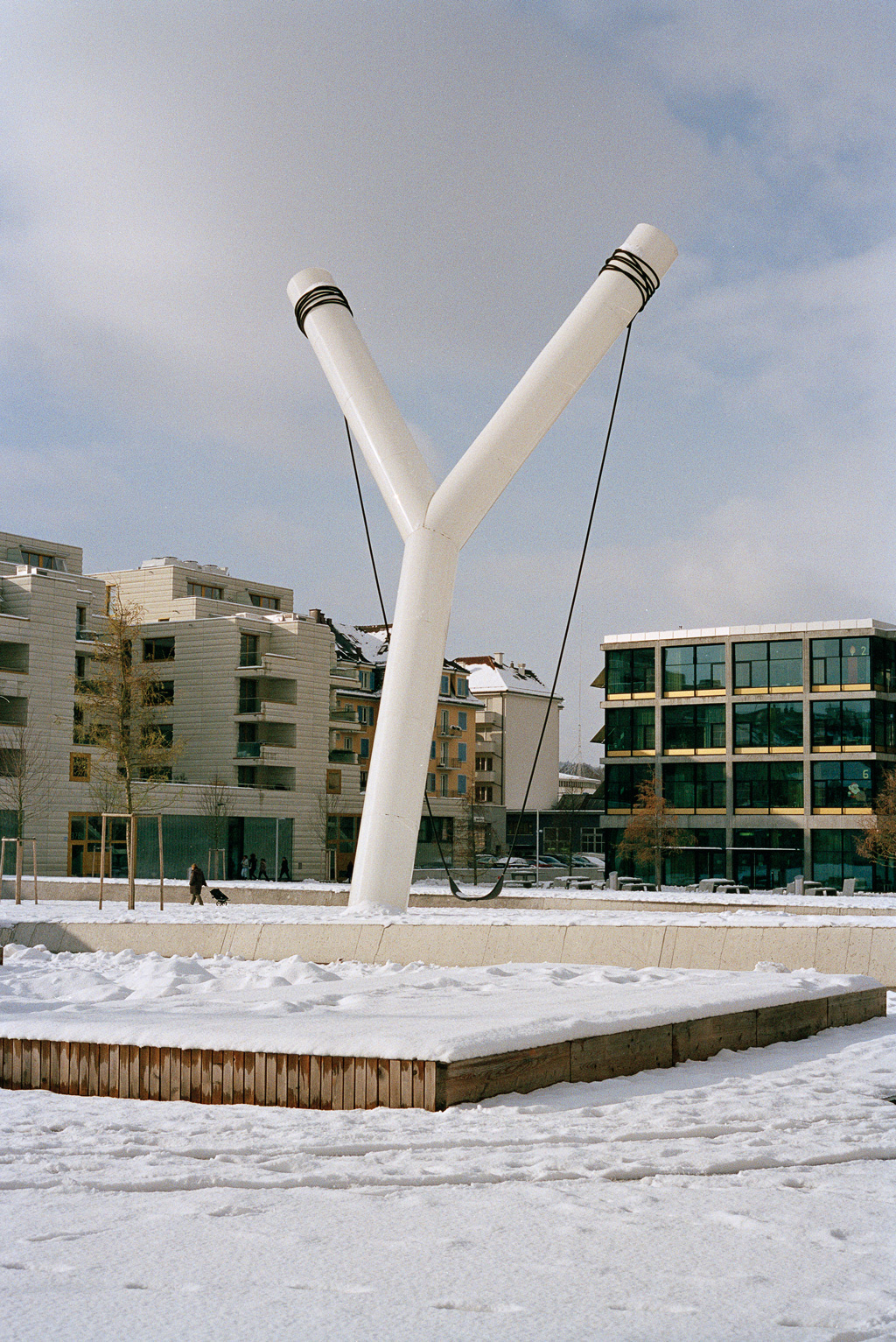
unten mit einem migros versehen – schliesst das Geviert ab, das nun den neuen Stadtpark Hardau bildet. Mittendrin steht die an ein Y (why) oder an eine Schleuder erinnernde Skulptur von Sisley Xhafa (*1970, Peja). Straff und fordernd erhebt sie sich gen Himmel, als hätte sich der Kampf Davids gegen Goliath in einem monumentalen Zeichen materialisiert. Das kämpferische Begehren wird aber nach unten zurückgebunden, indem die Skulptur zugleich Schaukel ist – die aggressive Geste wird in einer Art grosse Wiege mit endlosen Haltebändern aufgefangen.
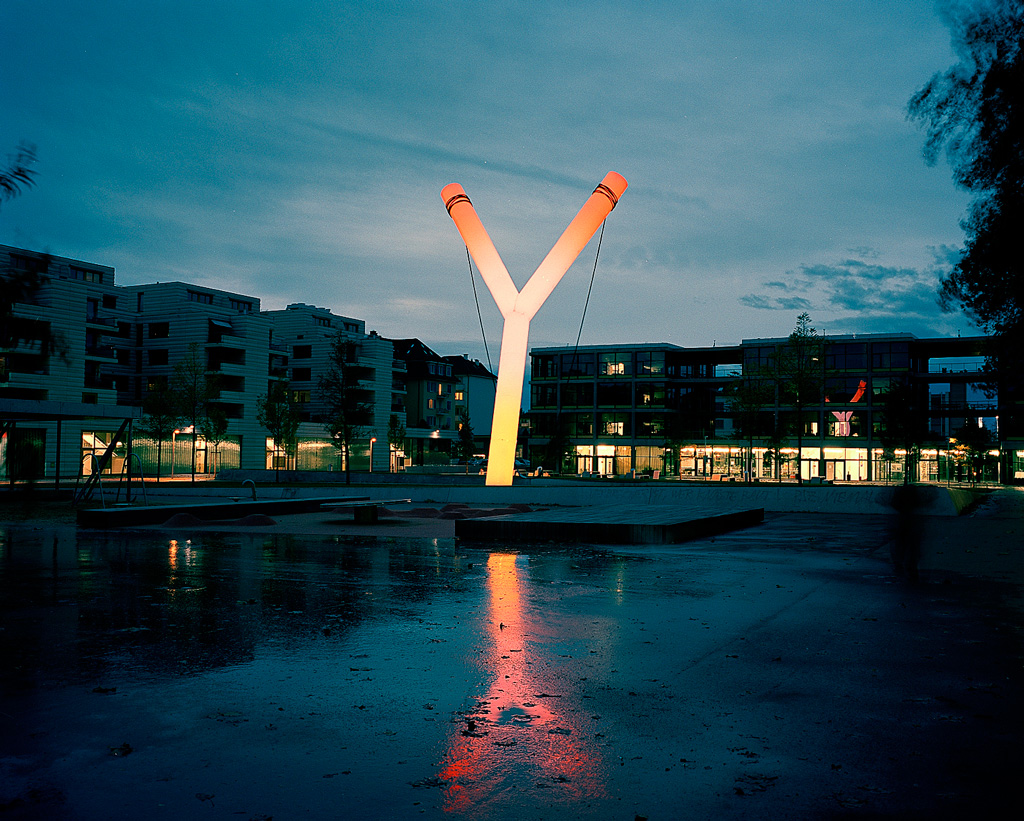
Der in New York lebende Xhafa thematisiert in seinen Installationen, Objekten und Perfomances «autoritäre Strukturen, Immigration und Illegalität. Ausgehend von seinem biographischen Hintergrund weist er auf politische und wirtschaftliche Missstände in unserer Gesellschaft hin», heisst es auf der Website des Zürcher Instituts für Gegenwartskunst, das für dieses Kunstwerk verantwortlich zeichnet. Xhafas Aktionen seien unbequeme Einmischungen in ein westeuropäisches Selbstverständnis, das noch immer Vorurteile und subtile Ausgrenzungen gegenüber dem Fremden zeige. Christoph Schenker – Leiter des Instituts – führt aus, dass die Arbeit ein Sinnbild für Transformationen sei, ein Mahnmal, das auch diejenigen, die «mit Beharrlichkeit im Wohlstand schaukeln» an die Gewalttätigkeiten, die mit Krieg und Migrationen einhergehen, erinnert. Kaum sind die Reden beendet, belagern die Kinder die grosse Schaukel und rangeln wild um einen Platz. Man hört Lachen aber auch enttäuschtes Weinen, weil nicht alle zum Ziel gelangen. Wenige Tage nach der Eröffnung war das ‹Y› schon beschädigt und wurde abgesperrt. Die zuständige Fachstelle wird aber sicher eine Lösung finden und die Hardau kann sich über das eigensinnige, nachts leuchtende Mahnmal freuen.
Anpassungsarbeiten
September 30th, 2011Frieze Blog: Bericht über Y von Aoife Rosenmeyer
September 29th, 2011In the Public Realm: Sislej Xhafa

On 23 September, Y (2011), a public sculpture by New York-based artist Sislej Xhafa, was unveiled in Zurich’s Hardau-Park. In light of this city’s recently chequered history in the realm of public art, the work is a triumph. Although Zurich boasts excellent art institutions, a decent collection of project spaces and healthy commercial galleries, recent headlines have nonetheless been embarrassing.
In December 2009, Zurich Transit Maritim, a much-publicized project of temporary art works to be sited on the quay of the River Limmat, was halted in its tracks when its budget was not passed by the Gemeinderat, the city’s parliament. The politicians’ move was a popular one, made during an election season, so the fact that contracts were already in place with artists Jan Morgenthaler, Barbara Roth, Martin Senn and Fariba Sepehrnia was of little consequence to them. Then, in September 2010, the far-right Swiss People’s Party (SVP) called a referendum that overturned the already-approved plan for Nagelhaus (Nail House), a public art project conceived by Thomas Demand and Caruso St John Architects. The Nagelhaus would have been sited under an overpass in Zurich’s Escher-Wyss Platz and was planned to house a café and kiosk. The proposal for their structure was based on the so-called nail house in Chongqing, China, whose owners refused to be relocated from their home to make way for new construction, thus stalling the demolition of their property for many years. The rumoured six million CHF budget for the Nagelhaus project was said to be too expensive (the SVP’s longtime ringleader, Christoph Blocher, is a major collector of Ferdinand Hodler’s barrel-chested Swiss wood cutters and the like, an indication of what he may believe is ‘suitable’ art) and the project was narrowly rejected, even though local voters had approved it and all of the permissions for building it had already been obtained. Ironically, in the meantime, another ‘nail house’ has emerged nearby in the form of one half of a residential building (the city owned the other half and bulldozed it) that remains at the feet of the city’s newest skyscrapers. Its residents and owner prefer their status quo to the city and developers’ version of progress.

Parallel to the making and the halting of these projects, the Institute for Contemporary Art Research (IFCAR) at the Zurich University of the Arts had, since 2004, been running the research project ‘Kunst Öffentlichkeit Zürich’ (Public Art in the City of Zurich, KiöR). The institutional research project looked at public art in the context of contemporary practice (frequently multi-disciplinary, with less clearly defined areas of expertise), new means of production of knowledge and the new demands that are made of public art, however diffuse and optimistic they may be. Their aim was to strengthen the societal relevance of public art in Zurich through two concrete outcomes. Firstly, they wanted to create a considered public art policy for the city and a municipal panel that would handle it. To this end, the KiöR working group was established in 2006 to lead the now-stalled Zurich Transit Maritim scheme. Further to that, their impact has been limited: their most visible activity is the ‘Gasträume’ programme, now in its second year, in which open spaces host temporary sculptural projects. While it has brought interesting works to the city, Gasträume’s limited budget largely excludes any participants other than artists supported by commercial galleries.

KiöR’s second objective was that their research would inform current public projects, and the Hardau-Park was a focal point for several stages of artistic input. This new park lies northwest of the city centre near the four Hardau tower blocks, one of the last and least successful high-rise building projects of the 1970s. The neighbourhood has one of the most rapidly changing populations in the city, with an above-average percentage of foreigners, particularly southeastern Europeans, who arrived in Zurich in great numbers in the 20 years since the end of Communism in that region.

Today Hardau is home to an uneasy mix of generations, ethnicities and incomes. Rather than attempting to paper over these gaps, the briefs given to artists presented the new park as a place of meeting and exchange, where differences would be brought into the open. The new park is part of general physical regeneration of the area, along with a new school built to cope with increased numbers of students, but the artists invited by IFCAR to propose projects for the park were asked to reflect on the differences in how the space will be seen and used, and to make positive use of this frisson.
Following temporary projects by San Keller, Claudia and Julia Müller and others, Xhafa’s permanent sculpture has just been inaugurated. The shortlisted artists – Maja Bajevic, Marko Lulic, Adrian Paci and Ayse Erkmen, as well as Xhafa – were chosen not so much for a shared background with many of Hardau’s residents, but for an understanding of the experience of dislocation. As Xhafa wrote in his proposal, if public art is complicated anyway, ‘for an expatriate, the relationship between meaning and form is not obvious at best and dislocated at worst’.
Xhafa’s sculpture is a 16-metre-high white catapult standing nearly upright in the middle of the green space. Its oversized elastic sling hangs down to provide a seat for one or two people. When someone is seated, the whole structure is illuminated from within by LED lights that make it glow in bright white, yellow and orange tones. It’s no secret that in Switzerland immigrant populations are frequent scapegoats, be it in the press or through demonization by conservative politicians, so Xhafa’s overt, if ludic, face-off with authority on their turf is fearless and delightful. In a time when the act of rioting seems purposeless (and Zurich is not immune to similar disturbances to those in London and Manchester of late), Xhafa’s symbol of resistance – David’s tool against Goliath – reminds us of such struggles. And at the same time, beaming in the night, it signals that that struggle can be a positive catalyst.
Ultimately the commissioners should be lauded for their brief, as should Xhafa for his response to it. It seems that within the relatively sheltered environment of academia, a decent project has been conceived and brought to fruition without being beset by the local political bickering which makes KiöR thus far seem toothless. Zurich’s art scene is enjoying a qualitative and quantitative boom, but this is a recently won reputation; at least the moment will leave one significant monument.
Den Beitrag auf der Webseite von Frieze lesen.