
Swiss National Science Fund (SNSF) project, 2025-2029
Performing AI’s goal is to contextualize AI as a dynamic social and cultural artifact that is discursively and practically constituted (that is, performed) in specific contexts and situations. In other words, what does “AI” do, why and how does it do what it does, and what effects does it produce across different disciplines? The project takes the theoretical and conceptual lenses of performance and performativity for navigating AI’s messy entanglements between the social and political, technical and aesthetic.
The project has three core objectives: 1) understand how AI is performed differently in its multiple constitutions (discursive, material, situated) and in/across disciplines; 2) provide interdisciplinary research and training opportunities for a next generation of researchers to grapple with the complex, multi-scalar nature of AI; and (3) explore new forms of critical public engagement with AI across arts, science, policy and technology.
Performing AI will thus study AI’s performances in the making in three sites – the policy space, experimental scientific and artistic research labs, and otherwise mundane spaces. Examining AI in the making, the project explores how AI is discursively enacted in policy and governance and examines the material agency of AI in robotics, artificial life and digital arts where human actors have to interact with machinic systems in real time. It also draws upon and develops ethnographic and ethnomethodological approaches to trace the situated action and production of AI in public settings of the everyday including a museum as well as in hybrid art, science and technology laboratories.
Project Partners/ Principal Investigators:
Anna Jobin (University of Friobourg)
Olivier Glassey (University of Lausanne)
Takashi Ikegami (University of Tokyo)
Christopher Salter (Zurich University of the Arts)
Zurich Based Researchers:
Diana Alina Serbanescu: Senior Researcher
Alexandre Saunier: Senior Researcher
Ilja Mirsky: Research Associate
From Cartographies and Critiques to Reconstructions and Reconfigurations / Reading Group
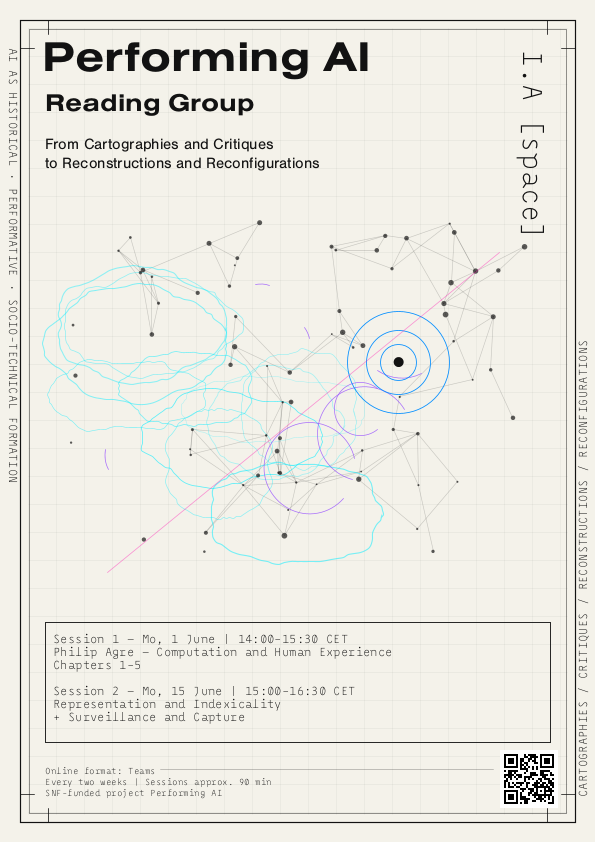
From Cartographies and Critiques to Reconstructions and Reconfigurations
The reading group revisits key moments in the history of AI in order to develop a critical cartography of the field. Together, we seek to broaden understandings of AI from a multidisciplinary perspective by rigorously examining its technical, epistemological, infrastructural, and social conditions, while attending to the gaps, tensions, and critiques within dominant AI discourse.
Drawing on perspectives from philosophy of technology, cybernetics, phenomenology, science and technology studies (STS), feminist theory, cognitive science, engineering, critical media studies, history of science, and complex systems research, the group approaches AI not simply as a technical domain, but as a historical, ontological, performative, and socio-technical formation.
Alongside critique, we are interested in how AI might be rethought through reflexivity, embodiment, situated knowledge, performance, relationality, and collective forms of sense-making.
Beyond its role as a space for collective study and discussion, the group aims to foster an international community of researchers, artists, theorists, and technologists collectively rethinking the conceptual and methodological boundaries of AI research across disciplines.
Session 1: 01.06.2026, 14:00 (CET)
Session 2: 15.06.2026, 15:00 (CET)
Duration: approximately 90 minutes
Format: Online via Teams (Meeting ID: 368 115 189 235 593, Passcode: 4hH7Mk3w)
The reading group will take place every two weeks.
Session 1
Philip Agre — Computation and Human Experience
Chapters 1–5 (“Introduction” to “The Digital Abstraction”)
Reading: https://memoof.me/read/889/pdf
Session 2
Philip Agre — Computation and Human Experience
Chapter 11 (“Representation and Indexicality”)
Philip Agre –– Surveillance and Capture
Readings: https://memoof.me/read/889/pdf / https://wtf.tw/ref/agre_1994.pdf