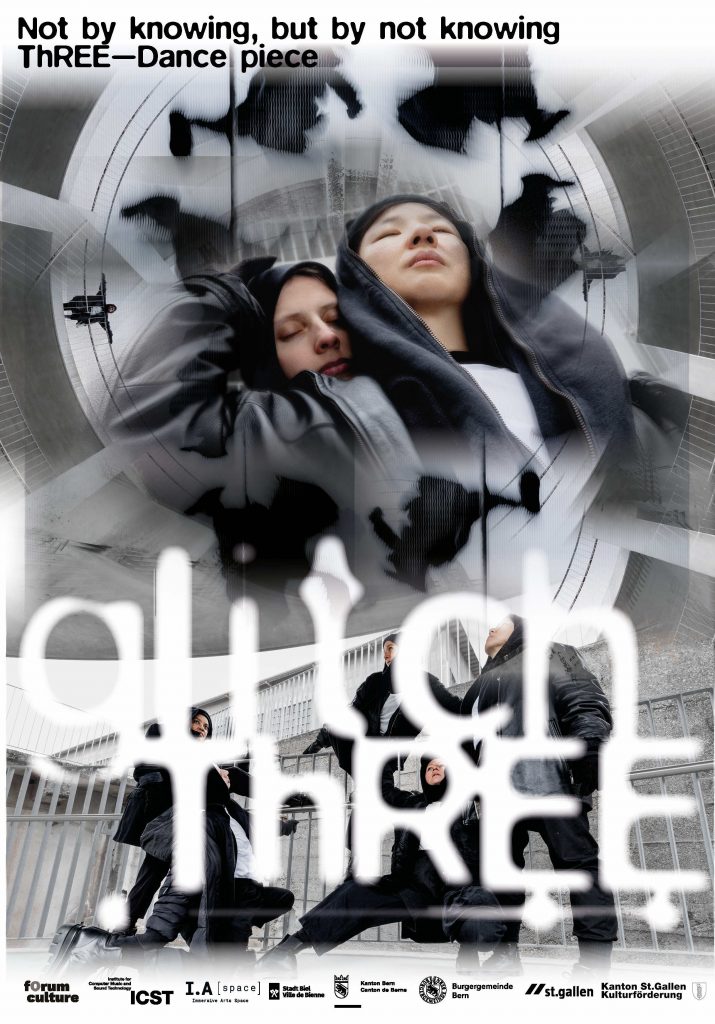
ThREE is a dance piece by the choreographer Stefanie Inhelder (Company glitch) and developed within the residency hosted by the Institute for Computer Music and Sound Technology (ICST) and the Immersive Arts Space.
Abstract: Three generations ago, Switzerland colonized Indonesia. Not only the country, but also the”women”. As a descendant of colonial concubinage, the choreographer Stefanie Inhelder carries both sides within herself. The audience is invited to dive into the sea between the fronts. In this in-between space we fathom the paradoxes that our ancestors have left us. Five performers move into the present with a minimalist core. Arrived we let the clear lines flow in a liquid polyphony – a decolonization of the feminine connotated body. ThREE is an immersive piece, that embraces the audience with an octophonic soundscape and holographic visuals. Through motion capture technology, the dancers’ movements expand throughout the theater auditorium. ThREE invites the audience to let go of clear sight and sides to find ourselves in the space between.
Credits: Stefanie Inhelder – artistic director, choreography Javier Munoz Bravo – composition and live electronics Stella Speziali (IAS)- visuals Eric Larrieux (IAS) – motion capture Anna Heinimann – performing dancer Kuan-Ling Tsai – performing dancer Laetitia Kohler – performing dancer Pascale Altenburger – performing dancer Thea Soti – performing dancer Jiaxin Chen – dramaturgy Andreas Zangger – historical research Lena Schmid – scenography, costumes Daniel Tschanz – light design Camille Jamet – production
reconFIGURE in an ongoing research project and offers an insight into a re-imagination of our world, the human body and movement by AI. Do we lose control over our represenation? The project aims to discover and highlight the shift of our images and embodiement once they are captured via computer generated data.
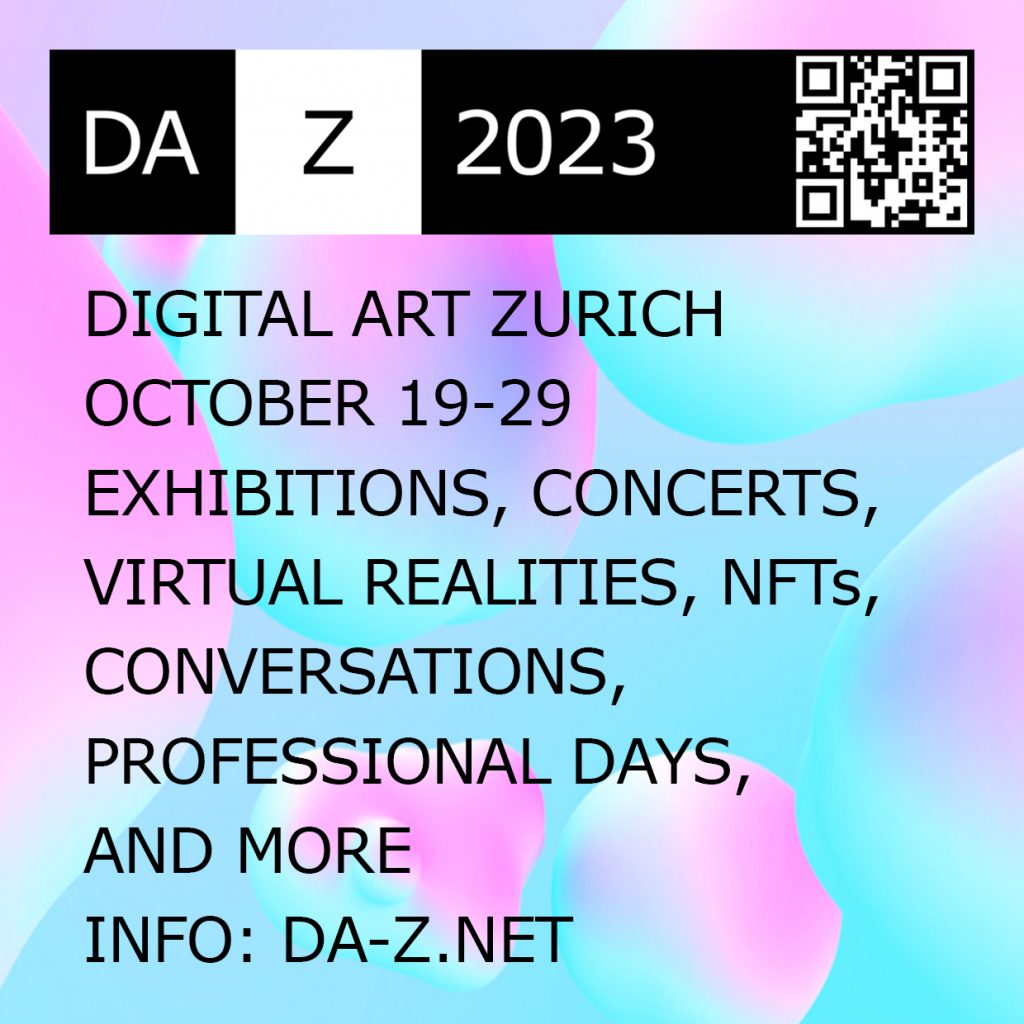
reconFIGURE will be shown during this year`s Digital Art Zurich (DA-Z). Tickets can be purchased [here]. Entrance is free for ZHdK students and employees.
Opening hours: 25th to 29th October 2023 | 15:00-19:00 £ Immersive Arts Space (1.J30), entrance via film gate (Förrlibuckstrasse)
Performance, 22nd September 2023 | 19:00 Immersive Arts Space (1.J30)
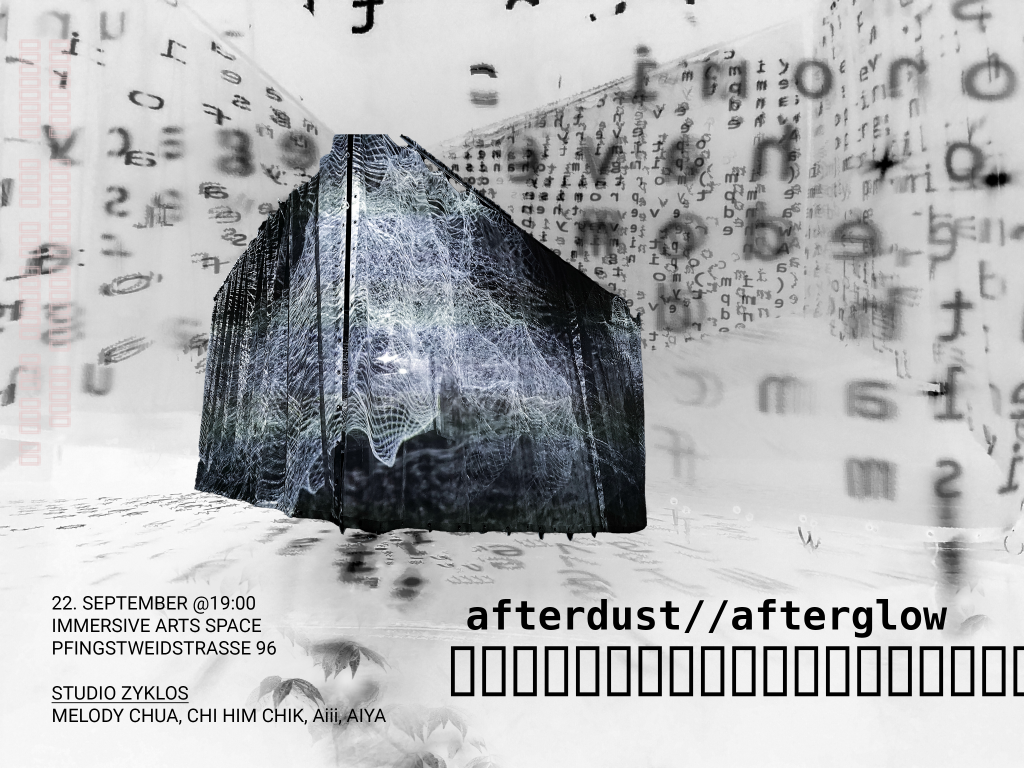
The phenomenon of phantom pain is when an individual experiences pain to a limb or an organ that is not physically part of the individual’s body, but perhaps once was and was removed—or was never even there in the first place.
In a radical empathy–turned hallucination, afterdust//afterglow makes allusions to the coping rituals we create around phantom pain, mourning, and death—the literal and the metaphorical, the overlooked witherings that occur within and between us and those right in front of us. Bright, blinding eulogies amidst unwavering resilience. It is the obsession of revisiting a memory in an attempt to find more life inside of it—even as we distort the memory with each access, and these distortions become our truths.
Concept/sound/visual composition/performance by STUDIO ZYKLOS (Melody Chua, Chi Him Chik, Aiii, AIYA)
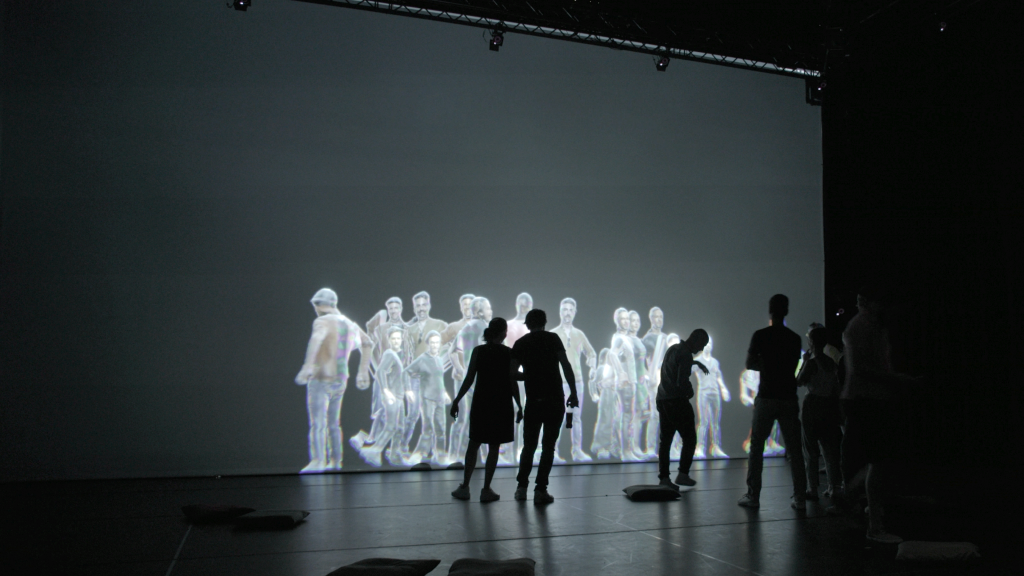
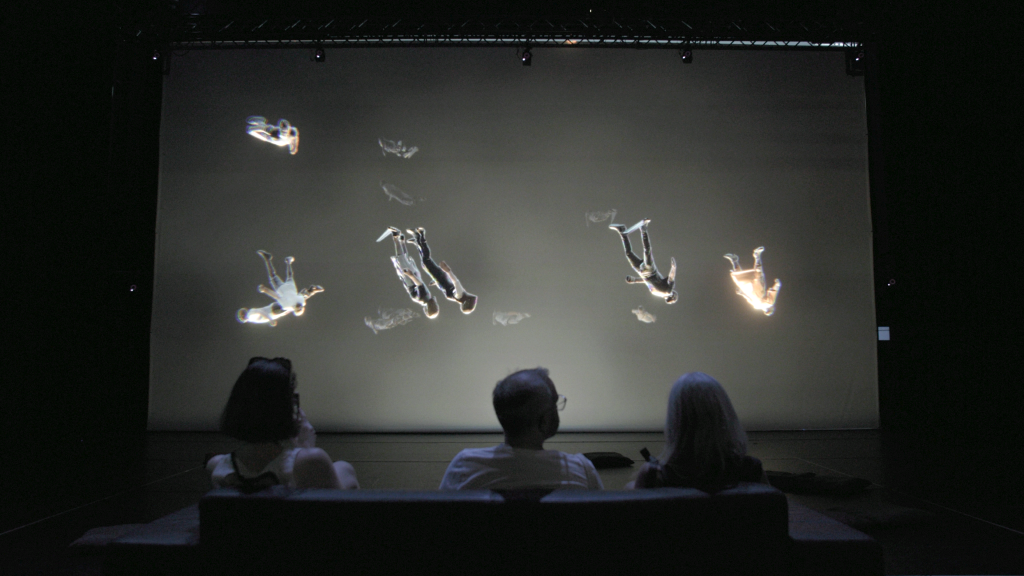
reconFIGURE is a real time installation exploring how diverse human bodies are reimagined by computing machines. The visitors’ frontal image is first captured by a camera, and using machine learning, transformed from a 2D image into an animated 3D avatar in a matter of seconds. Appearing in the projection on the wall and an unsettling sonic atmosphere, these doppelgaengers gradually seem to move like strange creatures in an aquarium, where hidden forces throw them around like rag dolls. As the visitors’ encounter their re-animated selves on the screens, they bear witness to the mutations generated by the machine processes. Thus, through the transformation of bodies by way of increasingly black boxed AI systems, reconFIGURE probes how we will negotiate the truth between our own image and that image as reimagined by machines.
reconFIGURE probes how computational systems capture, represent and transform human bodies [Hansen 20121; Hayles 20002]. In art theory and criticism, this theme has long been examined through concepts such as “technical exteriorisation” [Wegenstein 2010] and the “cyborg” [Haraway 20133]; “data bodies” [Salazar 20234]; and (3) the “undigital image” where a disconnect is felt between a subject and their body through computational image making [Zylinska 20205]. At the same time, the tension between a body and its captured other marks reconFIGURE as an encounter with digital “doppelgängers.” A term originally used by 18th century German writer Jean Paul, the doppelgänger is a ghostly counterpart for a living person, seen as an omen or sign of death
Aesthetically, reconFIGURE aims to highlight exactely this uncanny situation – the unsettling feeling that feels oddly familiar [Freud 2017]6 when confronting a digital other. To achieve this, we structure the experience in two parts: First, capture and transformation of the visitors’ body image and second, the reanimation of the image in an audio-visual environment that evokes the sense of bodies suspended in outer space or a liminal zone between life and death. This confrontation with one’s doppelgänger has an intimate quality yet, the doppelgänger quickly disappears from the display, reappearing in a larger projection in the room.
reconFIGRUE has already been part of the following exhibitions, conferences and festivals:
Credits: Chris Elvis Leisi: Experience Animation Florian Bruggisser: Volumetric Capturing, Machine Learning Pascal Lund-Jensen: Sound Design Martin Fröhlich: Scenography Chris Salter: Project lead Kristina Jungic: Exhibition Production
Mark N.B. Hansen (2012). Bodies in Code: Interfaces with digital media. London: Routledge. ↩︎
N. Katherine Hayles (1997). How We Became Posthuman. Chicago: University of Chicago Press ↩︎
Donna Haraway (2013). Simians, cyborgs, and women: The reinvention of nature. London: Routledge ↩︎
Constanza Salazar (2023). “Challenging the “Data Body” in New Media Art, 1990s–Present.” Afterimage, Vol. 50, Number 2, 93–111. ↩︎
Joanna Zylinska (2020). AI art: machine visions and warped dreams. London: Open Humanities Press. ↩︎
Sigmund Freud (2017). “The Uncanny.” In Romantic Writings. London: Routledge: 318-325. ↩︎
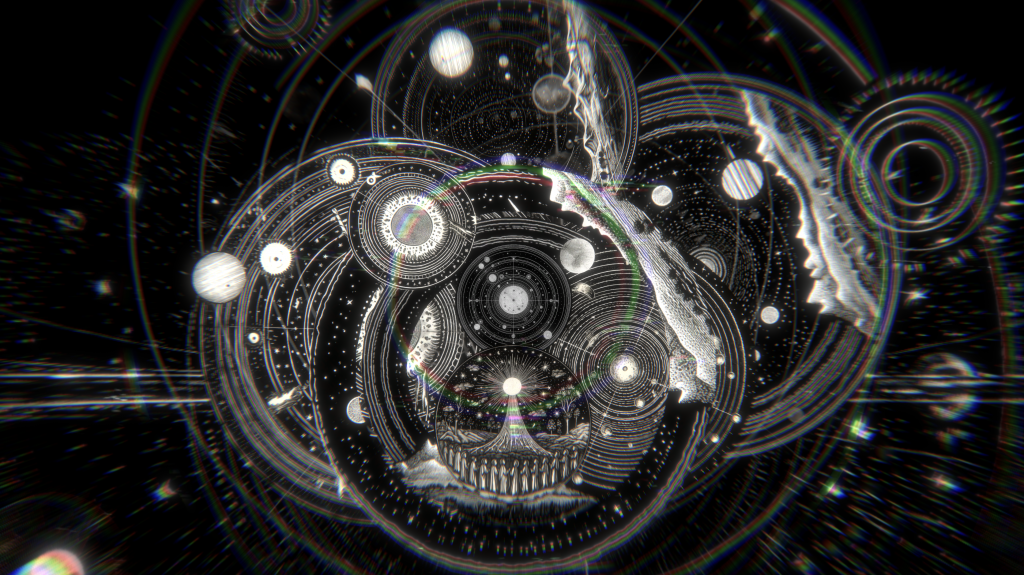
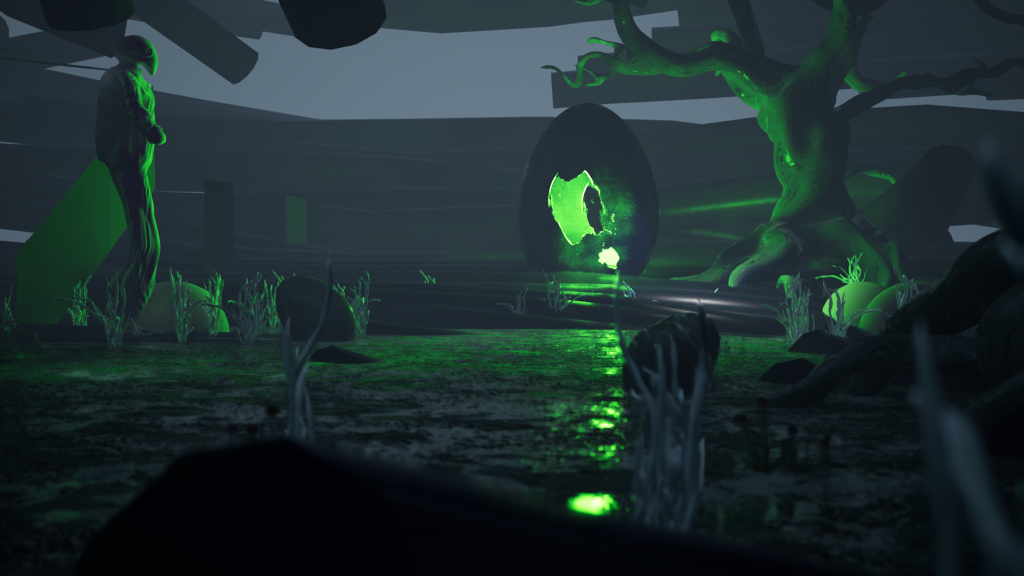
Possible worlds… is an augmented reality work developed by Oliver Sahli and Chris Salter that explores the 16th century philosopher Giordano Bruno’s proposition that the universe is infinite, animate and populated by innumerable other worlds. Using head-worn technology to blend the physical world with the computer world, the installation taps into the human fascination with creating meaning from patterns such as constellations of stars and planets.
Multiple visitors at a time wear head mounted displays, that allow the real physical environment to mix with animated visions of the cosmos beyond the physical space. At the beginning of the experience, the visitors are confronted with a ghostly apparition of Giordano Bruno created by motion capture that wanders through the observatory space speaking fragments of words from his 1540 treatise “On the Universe and Possible Worlds.” As the figure begins to vanish, the dome of the observatory is overlaid with a vast cosmological universe that the visitors then begin to travel through while lying on their backs. Speeding past stars and planets, asteroids and the still burning remnants of supernovas, the visitors eventually experience entering Gaia BH1, the closest dormant black hole to Earth which is only 1600 light years away but which suddenly becomes alive in the final moments of the work.
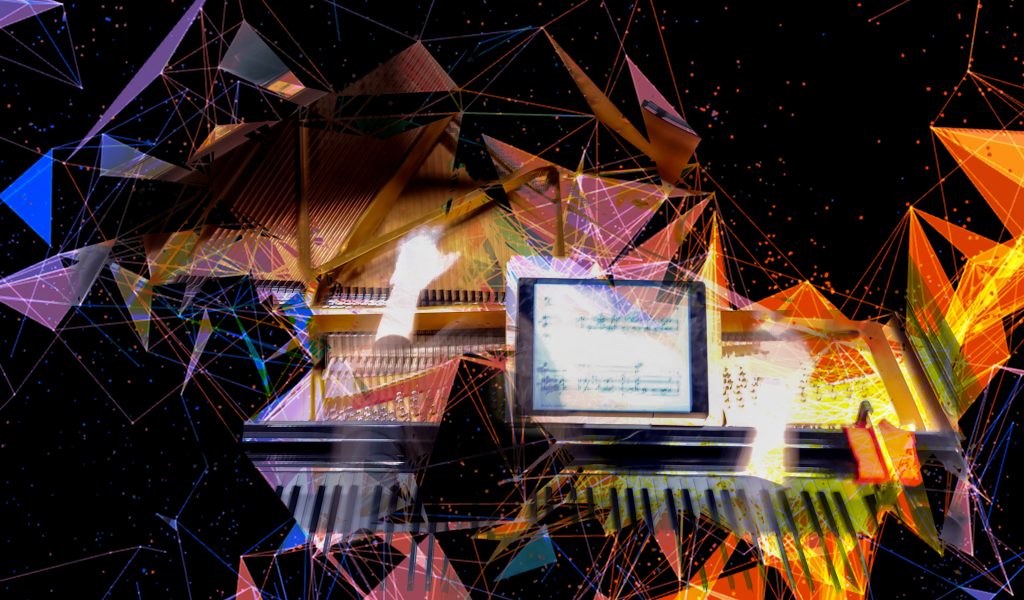
Work number 51 ½ for piano solo: Scene number 1 of the opera SAMSTAG (Saturday) from Stockhausen’s opera cycle LICHT (Light). Stockhausen`s first playing instruction: “The piano piece XIII should be performed like a magic spook”. Lucifer lies in a trance on a chair while the assistant Majella plays his dream on the piano.
A fever dream.
Lucifer is a drone. Every whistling, singing and tapping of the assistant on the piano is alienated. The Immersive Arts Space is immersed in animations choreographed by artificial intelligence. Concertgoers can move freely in the hall and listen to the various sound events. A game between man and machine, art and artificially generated values.
Performances took place on: 15th & 16th June 2023
Credits: Piano : Arianna Congedi Sound design, visuals: Jonas Renato Fuelmann AI Programming : Yuchen Chang Mentorship : Philippe Kocher Musical supervision: Till Fellner Dramaturgical advice: Annette Uhlen
Further support by : Kristina Jungic, Eric Larrieux, Martin Fröhlich, Marek Lamprecht, Paulina Zybinska, Antonella and Ruggero Congedi, Rama Gottfried, Federico Foderaro, Lara Wedekind, Mischa Cheung, Jean-Christophe Hannig, Hirschmann Foundation, Voice Technologies Switzerland.
A newly formed collaboration between the Immersive Arts Space and Pro Helvetia South America was launched in 2023. Within this framework, artists form countries in South America get the chance to do a residency in Switzerland. During that time they have the opportunity to come to ZHdK and work and develop their projects within the Immersive Arts Space.
Joaquina Salgado is a media artist and VJ from Argentina and is currently in Switzerland doing her residency. Her multimedia studies at the Universidad de Artes de La Plata led her to present her work in diverse exhibition contexts such as digital art festivals, night clubs, physical galleries and the metaverse. She has exhibited at festivals such as Mutek and Mirage, and collaborated on projects with Marshmallow Laser Feast (MLF). She is also part of Amplify DAI, an international network of women artists and curators working in the digital arts.
Her current project is called DERIVA. It is an audiovisual performance centered on the playing of cellist Violeta Garcia. With the help of motion capture, the music as well as the movements are transferred into a virtual world, which gives the audience new insights. The performance took place on April 28th 2023 in the Immersive Arts Space.
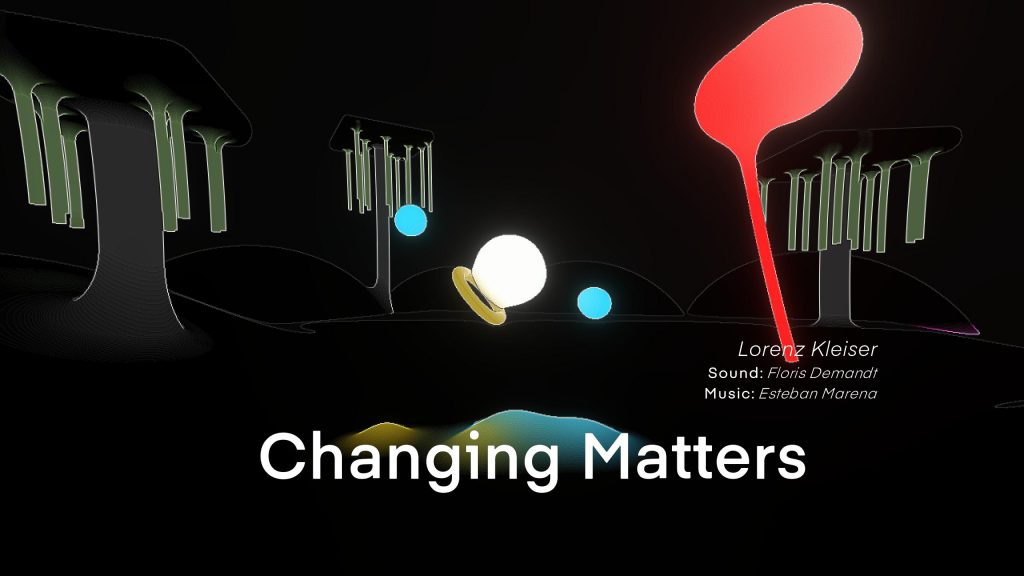
Changing Matters is a project that explores the concept of a playful and abstract virtual representation of oneself. This is achieved through the use of a camera that tracks the movements of the user and translates them onto an avatar. The virtual environment is further enhanced with sound that complements the user’s movements and empowers them with control. Therefore, experience encourages you to experiment with the possibilities of the virtual body’s interaction with the immersive sound and landscape.
The project utilizes SARMotion, a software developed by Florian Bruggisser, along with Unity data that is processed using Max/MSP and Ableton Live for sound generation.
Changing Matters is a graduation project by Lorenz Kleiser (BA Game Design) and Floris Demandt (MA Composition and Theory).
The project will be showcased and can be experienced at the upcoming conference REFRESH#5.
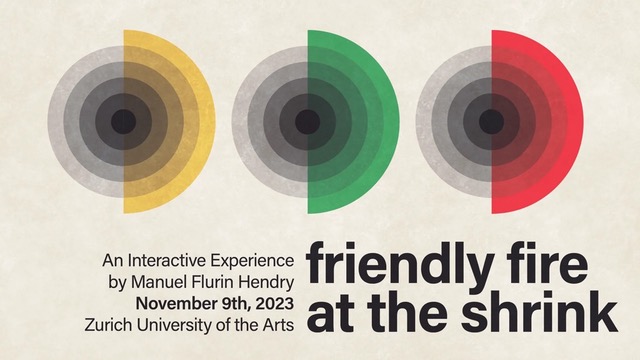
Friendly Fire is an interactive hommage to Joseph Weizenbaum’s psychotherapy simulation «Eliza» (1966), the world’s first computer chatbot. Weizenbaum was shocked by how quickly and deeply users became emotionally involved with Eliza – and how unequivocally they treated it as if it was human. As a German-born Jewish scientist who fled the Nazis, Weizenbaum worried about dehumanization. He argued that certain human activities – like interpersonal relations and decision-making – should remain inherently human, and that the uncritical adoption of AI could erode whole aspects of human life. Weizenbaum died in 2008. In 2022, the chatbot application «ChatGPT» was released and set a record for the fastest growing software ever, reaching 100 million users in just two months. «Friendly Fire» uses ChatGPT for a creative re-imagination of Weizenbaum’s work, exploring the fears and desires that artificial «intelligence» triggers in us.
Credits:
Manuel Flurin Hendry (Artistic Direction, Production) Norbert Kottmann (Programming) Paulina Zybinska (Programming) Meredith Thomas (Programming) Florian Bruggisser (Programming) Linus Jacobson (Scenography) Marco Quandt (Light Design) Domenico Ferrari (Audio Design) Martin Fröhlich (Projection Mapping) Stella Speziali (Scanning and Motion Capture) Hans-Joachim Neubauer, Anton Rey, Christopher Salter (Project Supervision)
Supported by Migros Kulturprozent, Speech Graphics Cooperation by Immersive Arts Space, Institute for the Performing Arts and Film, ZHdK Film
Friendly Fire was developed out of the artistic-scientific project The Feeling Machine, in which Manuel Flurin Hendry explored the question of artificial emotionality. “The Feeling Machine” is the PhD thesis of Manuel Hendry, which is part of the PhD program of the Filmuniversität Babelsberg Konrad Wolf and the ZHdK. Since 2022 the project is developed artistically-technologically in the Immersive Arts Space.
Find more information and by now six conversations of Stanley with different people here
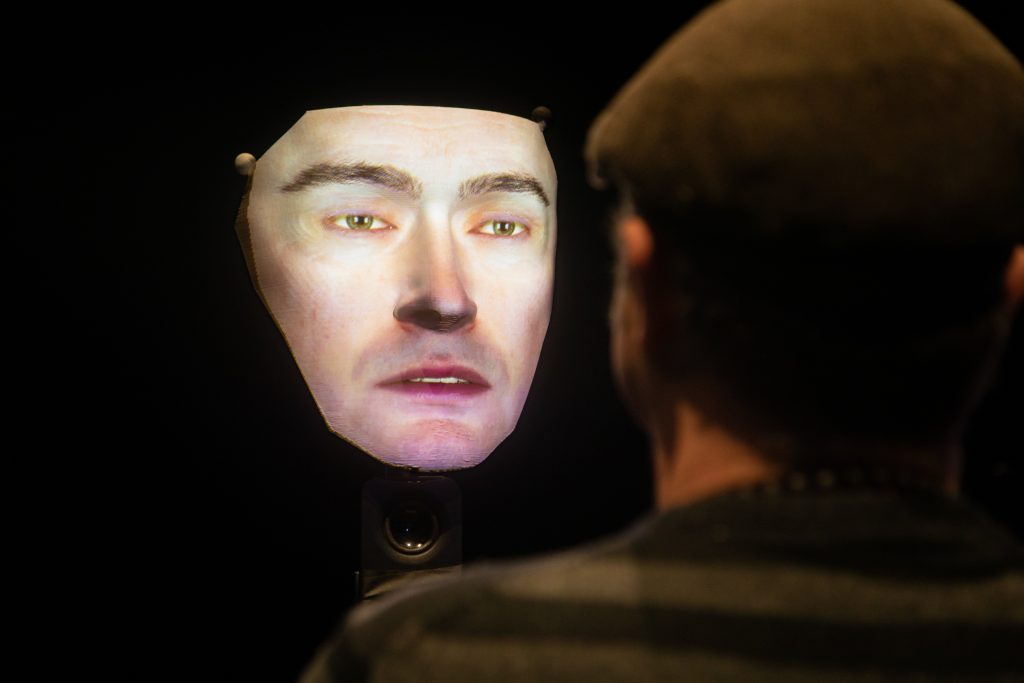
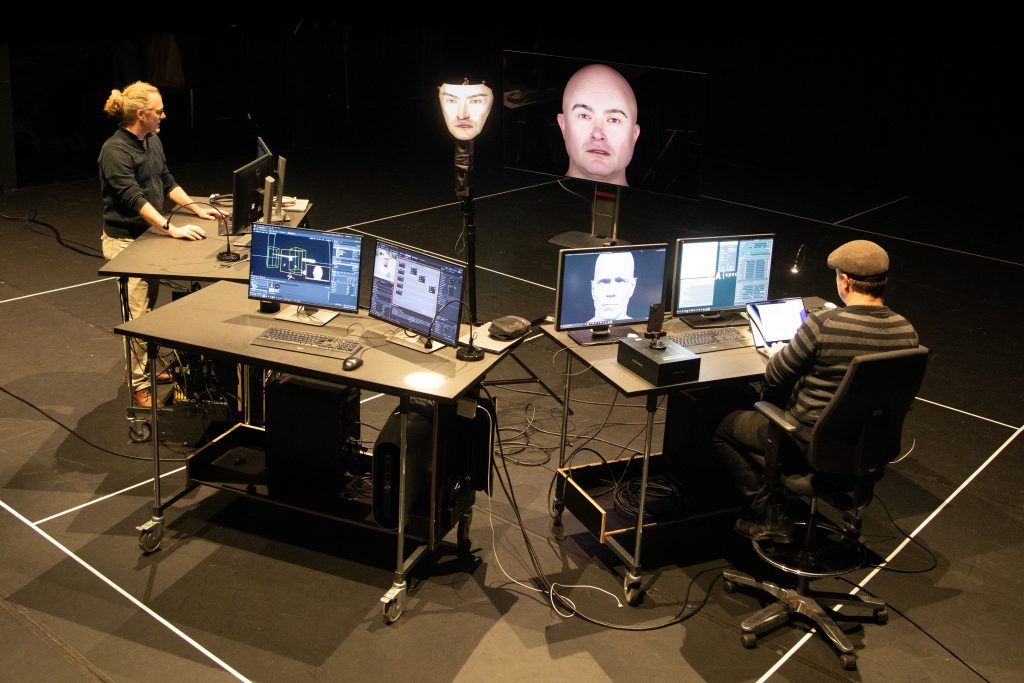
With the help of the so-called pre-trained Large Language Model (LLM), a speech algorithm, the linguistic simulation was developed. In months of development within the Immersive Arts Space and with the help of our scientific collaborators Norbert Kottmann, Martin Fröhlich and Valentin Huber, Stanley was born. In the early stagesa physical mask was developed with which the audience can converse directly in oral language in a museum-like situation. This being will be programmed as Unreal MetaHuman with the Omniverse Avatar Cloud Engine (ACE). Its physical form will be generated with projection mapping.
Stanley and The Feeling Machine were part of the exhibition “Hallo, Tod! Festival 2023” and on display for a chat in the cemetary Sihlfeld in Zurich. Read more about it in an article by the Tagesanzeiger
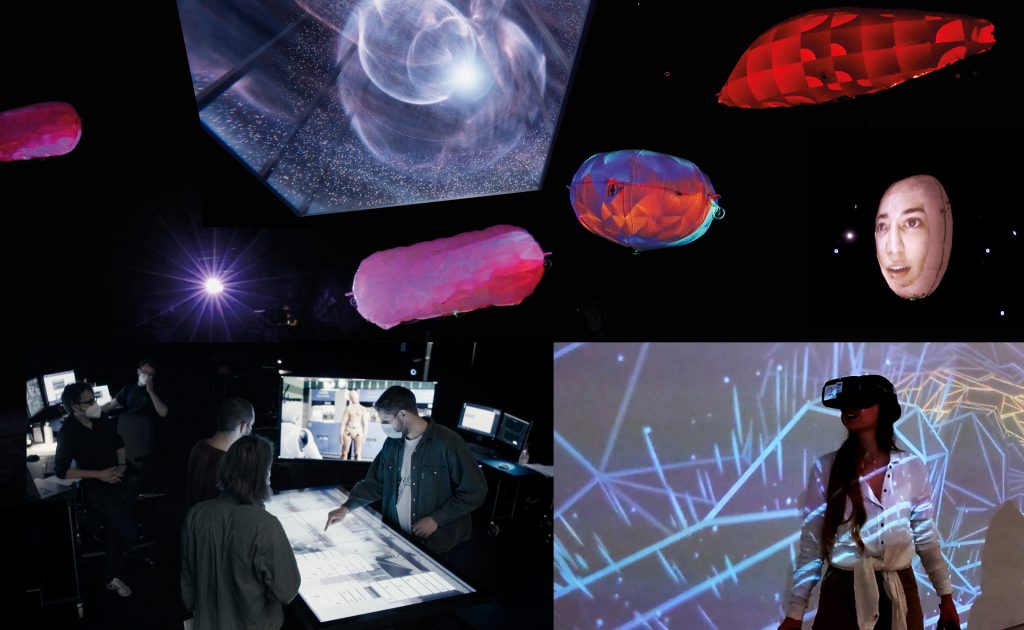
The LabInsights is a recurring event hosted by and in the Immersive Arts Space. At least once a year we open the doors to visitors and participants and showcase the current projects being developed in the lab. The informal event aims to demonstrate the state of the projects and at the same time involve students, artists and visitors to test the expereiences and give feedback.
Upcoming LabInsights will be posted on the website and our social media channels.
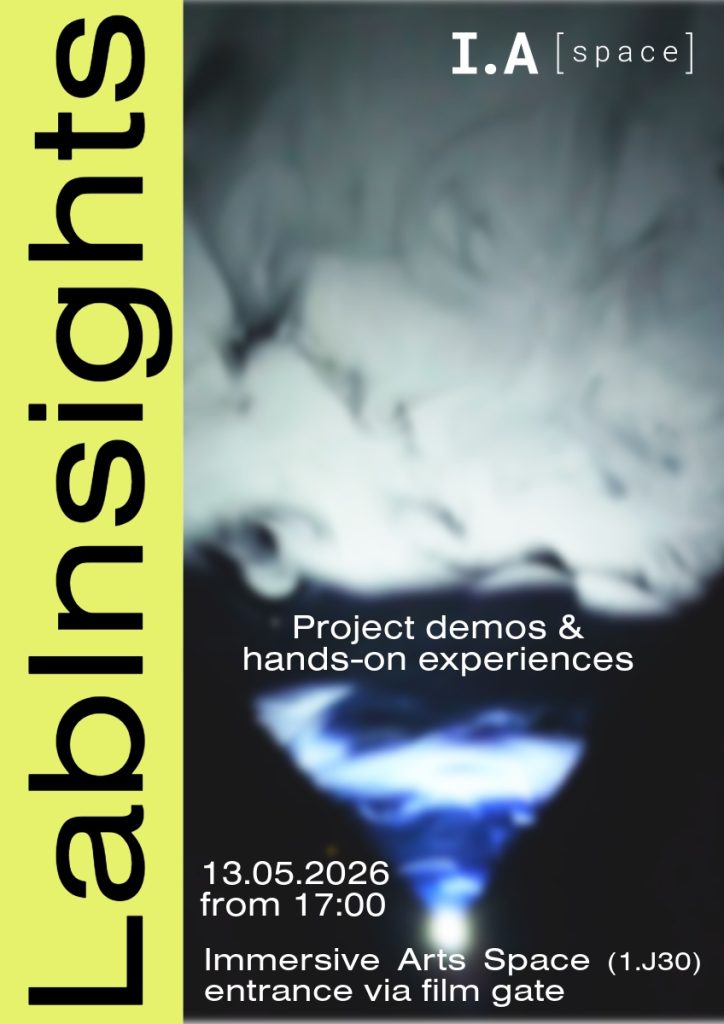
13th May 2026, from 17:00 on | Immersive Arts Space (1.J30)
The latest issue of LabInsights features a total of 8 experiences from various projects at the Immersive Arts Space. These include student projects from the T-Minor Immersive Art Advanced course, which have previously been shown at the Zurich Opera House. Additionally, several prototype projects from the SNF project “Probing XR’s Futures” will be showcased, covering the areas of design fiction, audio passthrough, and AI integration.
ZHdK members and external guests are cordially invited to stop by the Immersive Arts Space to test the projects, exchange with our researchers and enjoy a beer. No registration is required.
Featured projects are:
From T-Minor Immersive Arts Advanced in collaboration with the Opernhaus Zürich
Cardillac`s Mind Forge by Florian Gamillscheg & Hanna-Mo Krecjci
Hidden Truths by Stavros Balis
XX by Kishore Krishnakumar
YY by Sacha Schwarz
From SNF project “Probing XR`s Futures”
Prototype from Design Fiction, by Stella Speziali, Puneet Jain, Chris Elvis Leisi
Audio Mixed Reality by Pascal Lund-Jensen
Instructions for Use (AI encounter) by Oliver Sahli, Chris Salter¨
Further
Prototype of Val Mucilaginosa by Isabell Bullerschen (artist), Florian Baumann (3D artist) and Chris Elvis Leisi (experience design)
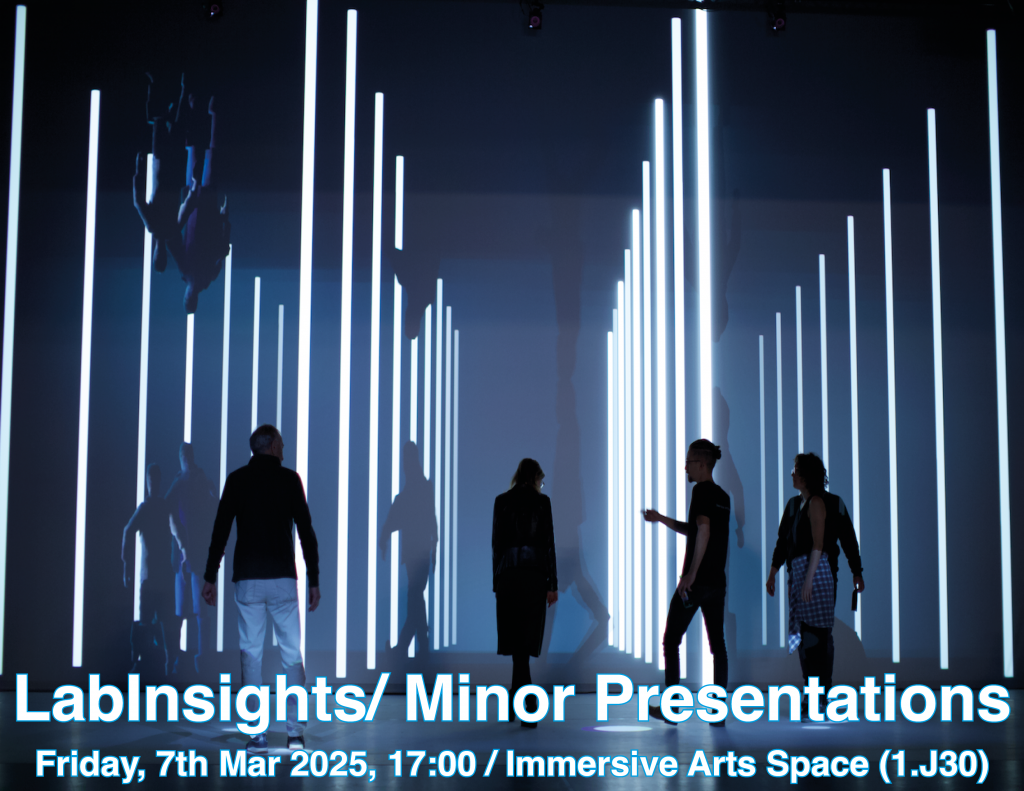
On Friday, 07th March 2025, the Immersive Arts Space opens its doors for an informal gathering. During the LabInsights students from the Immersive Arts Basic Minor will present their projects developed during the minor block weeks. In addition, two current project from our own research will be on display.
Minor presentations and apéro from 17:00!
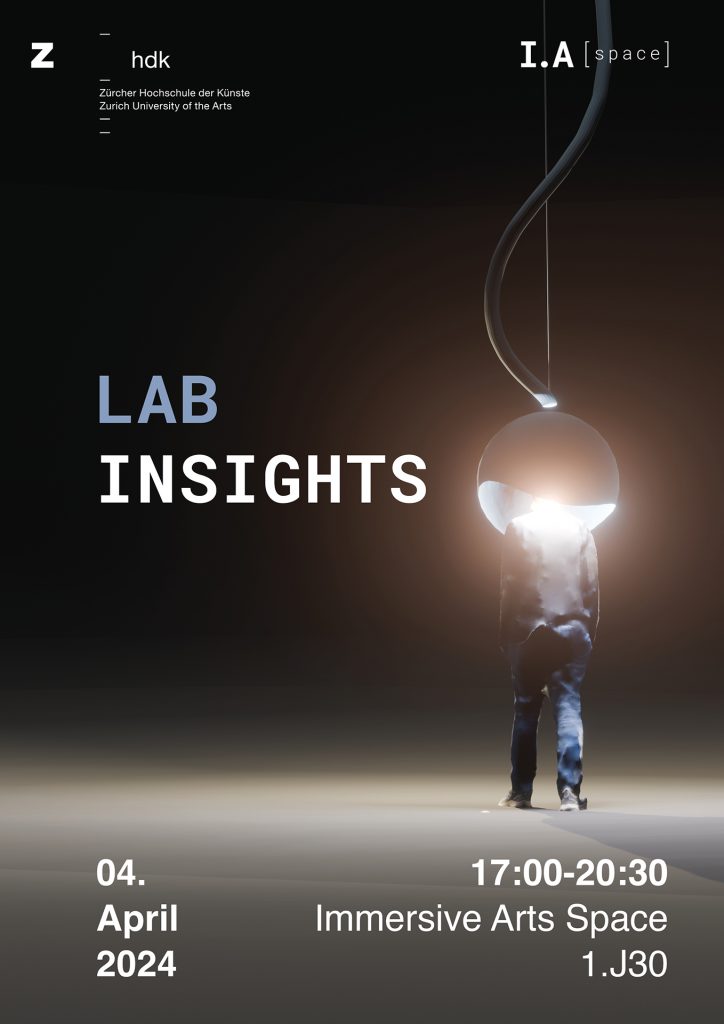
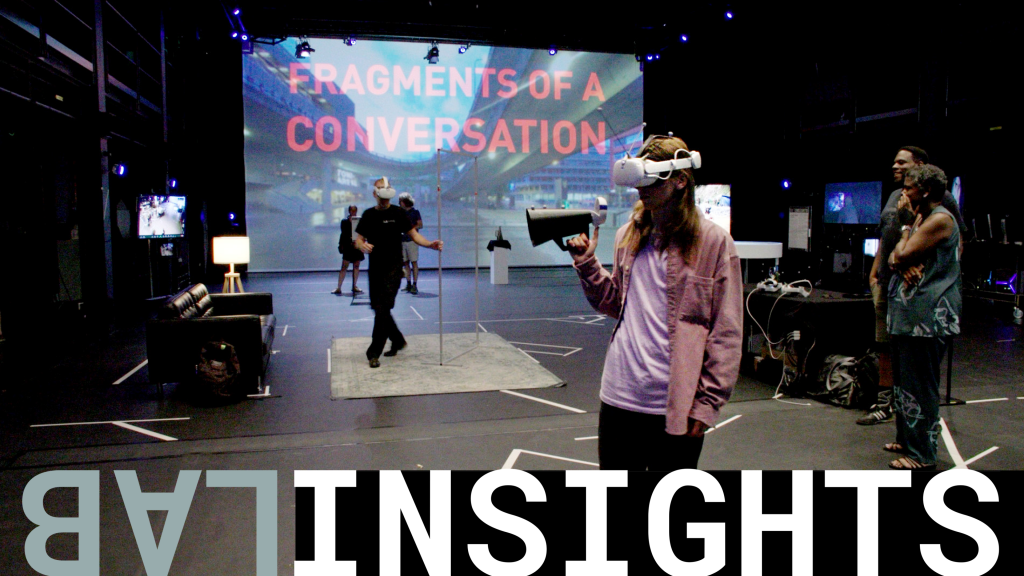
The next LabInsights will take place on 4th April 2024. This year visitors are invited to experience XRconFIGURE with Virtual Reality Googles and learn more about our latest work-in-progress projects and research such as Puppets, Probing XR’s Futures and Realtime Stable Diffusion. In an informal setting and with an aperitif it is a great opportunity to meet and exchange about current and new developments taking place in the Immersive Arts Space.
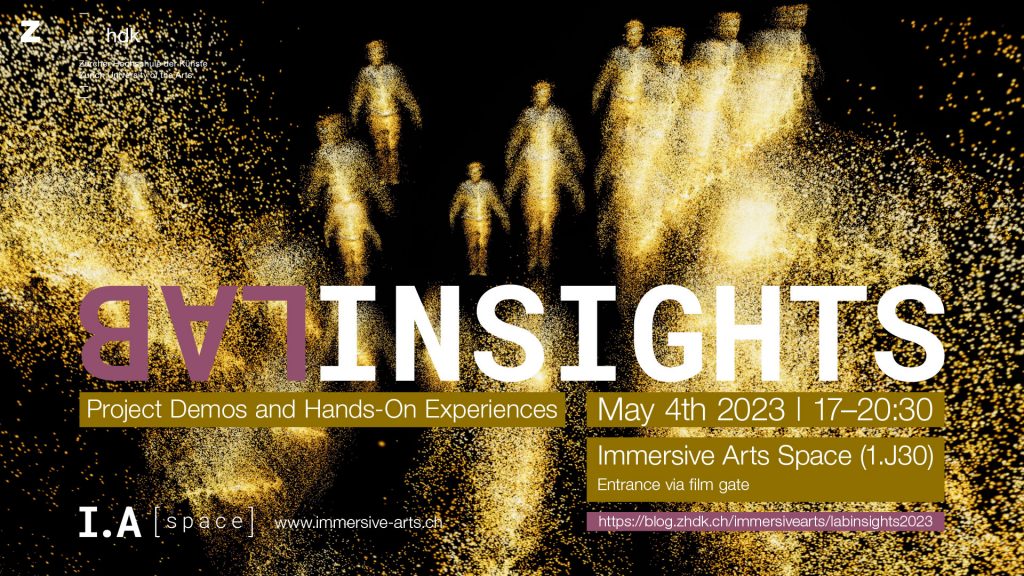
At the LabInsights, hosted on 4th May 2023, the following projects were presented: reconFIGURE (Chris Elvis Leisi, Florian Bruggisser, Chris Salter), Changing Matters (Lorenz Kleiser, Floris Demandt), Digital Gold VR experience (Chris Elvis Leisi) and The Feeling Machine (Manuel Hendry, Norbert Kottmann).
On 29th & 30th June 2022, the Immersive Arts Space presented new developments from current projects. Visitors were invited to experience our project Shifting Realities (Florian Bruggisser, Martin Fröhlich, Valentin Huber, Norbert Kottmann, Eric Larrieux, Chris Elvis Leisi, Oliver Sahli, Stella Speziali) with or without Virtual Reality goggles and to learn more about Digital Gold (Chris Elvis Leisi, Florian Bruggisser, Kristina Jungic, Christian Iseli) in our smartphones.
During REFRESH #4, from 10th to 11th November 2021, team members offered insights into the projects Shifting Realities (Oliver Sahli, Martin Fröhlich, Eric Larrieux and many more), Neural Volumetric Capture (Florian Bruggisser), Digital Twins (Stella Speziali) and cineDesk (Norbert Kottmann, Valentin Huber).